

Wednesday, May 23, 2012     News feed

University at a crossroads

May 25, 2011  

Norway’s first university, the University of Oslo, is celebrating its 200th anniversary this year at a time when more foreign students than ever are flocking to universities all over the country. Debate is rising over whether they should be charged tuition, not least in an effort to boost international rankings.
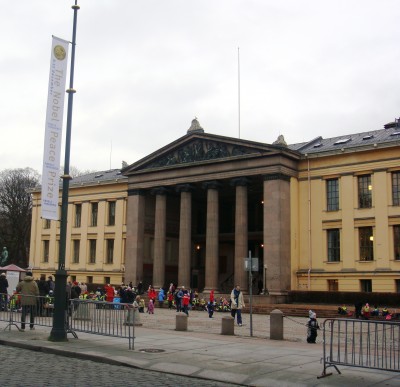
Norway's first university was set up in downtown Oslo, and this building called the Aula has just been renovated. The main campus is at Blindern, west of downtown. PHOTO: Views and News

Norway is now the only Scandinavian country where a university education is free to whoever can meet entrance requirements. Students from outside the European Economic Area had to start paying tuition in Sweden this year, leaving Norway alone in refusing to charge any university fees, either for Norwegians or others.

Svein Harberg, a Member of Parliament from the Conservative Party, thinks Norway needs to re-evaluate its lack of tuition, especially at a time when most university campuses face budget restrictions and huge demand for improved facilities. The simple fact that it’s free to study in Norway “can lead to such a wave of foreign students that we need to do something,” Harberg told newspaper Dagsavisen this week.

In countries like the US, where university education costs a small fortune even at state schools, it’s common for public universities to charge not only higher tuition to foreign students but also to students from other states. In Norway, the philosophy has been that a university education should be covered by the general tax base and be a social right along with health care and lower levels of education.

Harberg now worries that Norway’s lack of tuition can attract a lower caliber of student. “With Norwegian education being free, it can affect the kind of students who apply,” Harberg told Dagsavisen. “We can get another level of quality. Motivation is important, and if motivation for a student looking at Norway is only because there’s no tuition, we lose something along the way.”

The numbers of foreign students have risen dramatically in recent years, up 85 percent from 2002 to 2010. Last year, a total of 16,000 foreign students were registered at Norwegian colleges and universities. The largest single group came from Germany, followed by Russia. Meanwhile, around 20,000 Norwegian students studied abroad where they usually face high fees, but get much of them covered by the state and have access to state-guaranteed student loans.

There doesn’t appear to be much political support for introducing tuition at Norwegian universities. The student organization NSO fears that charging tuition to foreign students could lead to tuition for all students, and mark a step away from the Norwegian principle of education for all.

Alf Rasmussen of the Norwegian Centre for International Cooperation in Higher Education (SIU) believes the increase in international students will boost the quality of local colleges and universities. “We live in an international and globalized world, and that’s reflected in our educational system” Rasmussen told Dagsavisen.

Norway’s government minister in charge of higher education and research, Tora Aasland of the Socialist Left party, also has claimed there will be no proposals to introduce tuition from the current left-center coalition government.

Meanwhile, various celebrations are planned throughout the year in connection with the University of Oslo’s bicentennial. Events last weekend included an “Idea Festival,” various seminars and lectures. The university is also trying to build up its own alumni association, inviting thousands of former students back to campus last Saturday. More events are planned for the autumn.

Views and News from Norway/Nina Berglund
Join our Readers’ Forum or comment below.

To support our news service, please click the “Donate” button now.

Print Friendly

flattr this!


  • L Langberg

    I studied at the University of Oslo in an international program – ‘Masters of Public International Law’. In my class we had 28 students from 21 different countries around the orld. Harberg is completely wrong about the caliber of student free tution attracts.
    In my program the people were exceptional, and the diversity was quite simply inspirational. I come from Australia where we have a lot of international students, but I have never been in a class with such diverse backgrounds and perspectives. We had people from all over Europe and Africa, and many with incredible stories to tell and outstanding acadmic crudentials. The motivation was that they would come as far as Norway to continue their educations.
    The cost of living in Norway is prohibitive for many students, but they were motivated not by the free university fees, but by their desire to further their educations. It was truly a unique educational experience, and one that simply would not exist if students were charged fees – universities simply could not achieve this level of diversity with further financial limits on studying in Norway.

  • Radish

    Many countries have made ‘education’ a business. A good example nearby are the U.K. Universities. Education should not become a ‘commodity’.Yes, what is said above is correct. More than the course content the experience you get interacting with students from all over the world is fantastic especially at Masters level.I found it as a M.Phil student @ Trinity College Dublin in International Peace Studies.I think Norway’s approach is correct.

  • John Smith

    A higher education is not a basic human right, it is something that must be earned through sacrifice. I agree that it shouldn’t become a hugely expensive commodity like it is in the US, but expecting the Norwegian taxpayers to automatically fund higher education for people from around the world just because they meet admission requirements, is unfair to the taxpayer. These students could stay in Norway and contribute to society, or they could just as easily pack up and leave once they get their degree. There should be scholarship programs for truly exceptional students, and financial assistance programs for highly qualified students, this should keep attracting the best talent and maintain diversity. There are many people who work hard and pay tax in Norway who do not have a university degree, and they shouldn’t be expected to fund somebody else’s decision to pursue higher education.

  • Sam

    “John Smith”, your response is what the Norwegians would call “smalig”. You miss the forest for the trees and are focusing on petty squabbles about the Norwegian taxpayer.

    The fact is that this is a type of cultural exchange. That is what is being funded. Of course if you would prefer that Norway stays a small isolation country that no one knows or cares about or has a reason to learn the language, then yes it makes sense to quibble about the “taxpayer”, well that is if you skip the fact that the average Norwegian taxpayer had very little to do with this and the money in truth comes out of a hole in the North sea, before it ever reached a taxpayer.

    As for whether there are Norwegians who dont take higher education, this is no loss, as anyone who has ever hired a plumbler, electrician or in fact any sort of tradesman in Norway. The fact is that four years after graduation, that foreign studnet or even a Norwegian univerity graduate, is probably making the same or less than a Norwegian with no college education and 4 years of trade industry qualifications.

    This smell like good old modern xenophobia to me. You wave the word “foreign” anywhere in Norway these days and there is sure to be someone wagging their finger and making negative remarks about the foreigners.

  • John Smith

    Sam, I think you’ve missed my point entirely. First of all, I cannot be xenophobic on this issue because I’m not from Norway, so I would have to be prejudiced against myself.

    Also, what evidence do you have to support your contention that the University of Oslo is entirely funded by “a hole in the North Sea”? Even if it was, that’s an opportunity cost, that’s money that could be spent on other public projects that benefit everyone. The fact is, only the interest on the oil fund is used each year to augment tax revenue, and that is spent on a multitude of things.

    As someone with a heavy tax burden, and 6 years of paid university education under my belt (in the US), I don’t understand why I should be required to also fund somebody else’s education, especially if they have not themselves contributed to tax revenue, or don’t intend to do so after they graduate. Like I said, if they are exceptional students that are above and beyond a typical incoming class, then they can qualify for financial assistance or scholarship, as is the norm in most other countries (that still manage to have more diversity than Norway).

    Anyway, I think this is a basic ideological difference between us, and I don’t expect to convert you. I am a fiscal conservative and I believe in individual responsibility, not collective welfare-ism. So maybe it’s my fault for coming to the wrong country.
