

Saturday, May 18, 2013     News feed

French tourist jailed for speeding

August 21, 2012  

A French tourist who was caught driving at excessive speed over a scenic mountain highway in north-central Norway has lost his driver’s license and been sentenced to 18 days in prison. It’s an unusually harsh punishment, especially against a visitor to Norway, but prosecutors claimed the French motorist put others’ lives in danger.
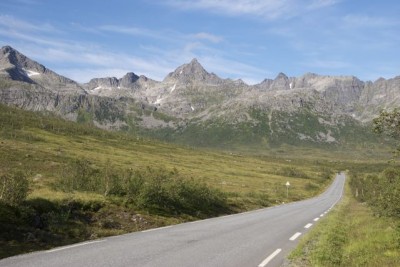
It can be tempting to drive fast on some of Norway's nearly deserted highways in wide-open country, liked this one in Nord-Troms, but a court father to the south in Salten has proven that punishment can be swift and that tourists can be held as accountable as locals. PHOTO: Views and News

Newspaper Avisa Nordland reported that the man from France, in his late 30s, was driving 160 kilometers per hour/kph (nearly 100mph) when police nabbed him in a speed control operation they’d set up on the two-lane E6 highway over the mountains of Saltfjellet. The speed limit in the area is 90kph (55mph), and police had followed him over a distance of seven kilometers before pulling him over.

Police feared the French tourist, who works as a director of a large French company, would try to avoid punishment in Norway, so they immediately jailed him pending legal action. His court appearance was set for the day right after he was caught last Thursday, and by then he’d made an unconditional confession to the speeding infraction.

The local court (Salten tingrett) sentenced him to 18 days in prison, revoked his driver’s license for 16 months and ordered him to take a new driving test in order to get it back. That was exactly what prosecutor Stig Morten Løkkebakken had requested.

“It’s quite unusual to jail anyone in connection with a speeding violation, but in this case, the speeding violation was both considerable and deliberate,” Løkkebakken told Avisa Nordland.

Løkkebakken noted that the French tourist had admitted he was driving fast because he wanted to “test out” his rental car, a Volkswagen Passat CC. Police and prosecutors thought it was thus important for the man to face sentencing by a court.

“The speed at which he was driving posed high risk and put other persons’ lives in danger,” Løkkebakken said.

The Frenchman, who wasn’t identified in keeping with Norwegian press tradition, reportedly had been on holiday in the scenic northern archipelago of Lofoten, and was driving south over the mountains on his way to Stockholm, where he’d intended to fly back to France. Now he faces time in a Norwegian prison, while authorities in France would be alerted to the revocation of his driver’s license.

Views and News from Norway/Nina Berglund

Please support our news service. Readers in Norway can use our donor account. Our international readers can click on our “Donate” button:




  • NorwayExpat123

    Simply asserting that what this man was doing was “putting people’s lives in danger”, without detailing the conditions under which he was speeding, is completely ridiculous. On clear days with low traffic, traveling on a Western highway in a modern vehicle at “speeds approaching 100mph” can be perfectly safe. That’s why they do it on the German autobahn, and it’s the safest highway in the world. I’ve never met a European driver that hasn’t driven 150kph+ on a two lane highway in continental Europe, including very responsible middle-aged parents.

    Inattention is a bigger killer than speeding; I’ve been absolutely terrified sitting as a passenger in a car going 10 below the speed limit, and felt completely safe in cars at speeds much in excess of 100mph. The condition of the car, the experience of the driver, the situational awareness and focus of the driver, the traffic level, the weather conditions etc. all have more to do with safety than some arbitrary number some bureaucrat decides is a safe speed. The problem is, it appears to be easier for those in power to enforce some quantitative measure of safety than using common sense. As usual, the public pays the price for this with reduced safety, and pointless fines and imprisonments.

    The excessively low 70kph speed limit in the tunnel under central Oslo is ignored by most drivers, who slam on their brakes where they know the speed cameras are, then floor it back up to 100kph+. I doubt that’s any safer than what this tourist did, but the majority of Oslo drivers do it every single day.

    How about setting reasonable speed limits that people can adhere to without being passed left and right like they’re standing still? When you put absurdly low speed limits, very few people actually adhere to them and then they figure if I’m going to go 20 over, why not go 40 over? That creates a huge disparity between speeders and the few people who actually go 70kph through that tunnel, which is even more unsafe.

    I tried going 70 in that tunnel for a while in my modern, maneuverable, and safe executive saloon, and then got sick of huge, heavy trucks passing me left and right.

    I am not defending the tourist in this case, but I am not ready to conclude he was being unsafe merely based on the speed he was traveling, which is almost all the information we have.
    We also know he was in a modern, well-maintained (rental), German saloon car with electronic stability control, ABS, and he is approaching 40 so he likely has a lot of driving experience. Life-threatening? I think not.

    That’s my two cents, if you feel inclined to disagree please do so without calling me names, thank you. To preempt the straw men, no I’m not saying we should abolish all speed limits, I am just asking for common-sense laws and enforcement.

  • Kristian

    Dear NorwayExpat123,

    I understand your frustration over what may be felt to be exceedingly low speedlimits, and it is likely that the specific situation in which the French tourist speeded was perfectly safe. However:

    Having driven on German roads for 20 years, I can assure you that Norwegian traffic is heaven! I like cars (I am German) and I like going fast, I think it’s fun. But the downside of it is
    a) it makes you agressive: the constant battle on German roads, not just Autobahn’s, over virtual race positions is either frustrating (when sharing your experience of sticking to the limit) or is extremely stressful (when taking part in the race to the next red light),
    b) as a result of that it is very challenging to bike, because you’re seen is an obstacle in the race,
    c) it’s dangerous: I have no figures to back up that claim, but I’m pretty sure,
    d) it carries avoidable environmental and health consequences,
    e) it doesn’t get you there any faster. Standard speedlimit in German towns is 50 kph, average speed is 24.

    Your argument on inattention is very true, but is misses one point: perfect or imperfect conditions and low speed are safer than the same conditions and high speed.
    What exactly is it that could outweigh the the potential consequences of a 160 kph car hitting someone? If you want to go fast for fun you have every right to: rent a car and go on any of the big race tracks, Nürburgring for instance, that’s no problem. You can drive like madness and endanger no one but yourself.

    I don’t know what reasonable speed limits you have in mind that people will happily follow, but the standard in Germany is to exceed them by 10-20 kph. Regardless of what they are. Everyone does that, I do, too: fines are minimal.

    I know I come from the extreme end of traffic regulation, but again, in my experience, the way Norway regulates is perfectly sensible.

    With best regards.

    • NorwayExpat123

      Hi Kristian,

      Thanks for your comment. I think we are in broad agreement, but there are a couple of things that were the focus of my comment that I would like to reiterate.

      The police are imposing a very harsh, life-altering punishment on a man who, for all we know, was not being any more unsafe than a large number, perhaps even a majority, of other drivers. They are making possibly one of the harshest accusations you can make to someone, that they are endangering the lives of others. Big accusations require big proof, but they are only telling us his speed, and nothing else that would pertain to the level of safety-conscientiousness he was exercising.

      To illustrate my point, imagine a teenager driving on the same road in near-icy conditions, in a 20 year old, poorly maintained, heavy pick-up truck, with balding tires, traveling at 120 kph while eating a sandwich. This would likely just result in a fine or two, but if I was forced to bet on which would be more likely to cause an accident, I would bet on this hypothetical teenager rather that the tourist in this case (or a hypothetical tourist on a clear summer day with low traffic etc).

      All things being equal, of course at lower speed you’re probably less likely to have a crash, like you said. However, life is never that simple, all other factors are rarely equal, and therefore, traffic enforcement should take other factors into account other than just speed, especially if they’re going to jail people.

      I will agree that driving in Norway can be less demanding than driving in Germany; compared to the level of attention required on the autobahn, you’re practically sleeping at the wheel here. Well, you would be sleeping if you did not have to check your speedometer every 3 seconds, and scan for speed cameras because you’re forced to go 10-20 over, and you cannot afford the obscene fine you’re likely to get for that.

      The tunnel I was referring to was the E-18 highway’s Opera Tunnel, which has no traffic lights, and three lanes of traffic often traveling 20-40kph above the limit. There are many other roads all over Norway where the authorities have set the limit at least 10-20kph below what many would regard as reasonable, and I am convinced this is actually having an adverse effect on safety and fuel economy.

      Best regards,
      NorwayExpat

  • Cyclestrian

    Great result and superb example to set. Norway’s roads will be safer and road injuries reduced as a result of proper enforcement. Why can’t police and courts in other countries man up and follow this example?

    To “NorwayExpat123″: it’s not about you. It’s not about the driver or passenger “feeling safe” at x kph because they know they have ABS, ESP, airbags, etc. Speed limits protect everyone – there might be walkers or cyclists using those mountain roads. Can you really doubt that this tourist was not a danger to others? At these speeds any collision is likely to be fatal, even to the “protected” driver.

    Another issue people forget is that speed limits are not only about road safety, they are about improving the local area. Look at the picture above. If I’m enjoying the mountains, perhaps hiking or camping, I really don’t want to hear cars ripping through the cols at 110-160kph. I am there to get away from it all. Noise increases dramatically with speed. Same principle as residential areas: cars accelerating to 50kph and braking again are noisier to those limited to 20/30kph. My street would be a much nicer place if people cruised sedately by at 25kph rather than being in such a hurry at 55kph. It’s not all about the people in the car and unfortunately the only way to tackle speed is with “arbritary” limits.