

The Norwegian Nobel Committee sent a message to national leaders around the world, not least in the USA, when it announced this year’s winner of the Nobel Peace Prize. It went to Navanethem “Navi” Pillay, a champion of upholding international law and not least in her role as a judge on the International Court of Justice, at a time when both the law and the court are under “enormous pressure.”
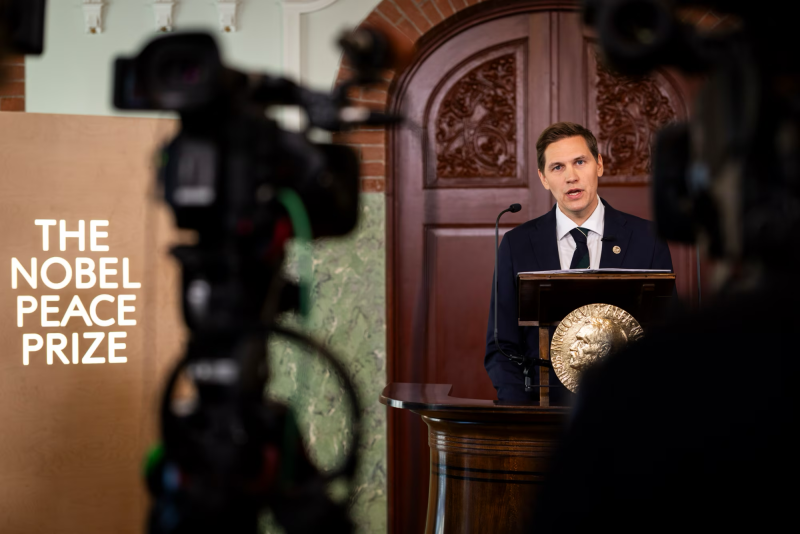
“This year’s laureate has been instrumental in ensuring that war crimes, crimes against humanity and genocide are prosecuted,” said Jørgen Watne Frydnes, leader of the five-member Norwegian Nobel Committee, at the annual Nobel Peace Prize announcement in Oslo. He stressed at the outset that Pillay, “with exceptional courage and integrity,” has “led the way towards a more comprehensive global legal order” and thus plays a key role in promoting both peace and international law.
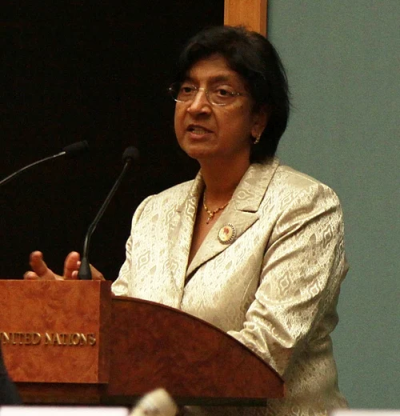
According to Frydnes and the Nobel Committee, “international law is the foundation for a more peaceful world.” He added later that international law “is an absolute necessity” for peace, as he urged more support and respect for the international courts that strive to uphold it.
Both the International Court of Justice and the International Criminal Court in The Hague have long been candidates for the Nobel Peace Prize, and nominated year after year. Asked by Norway’s TV2 why the committee opted to select Pillay as a judge on the International Court of Justice, instead of the court itself, he noted that court systems “are not perfect” and it’s the individual people behind them who can make a difference.
He cited Pillay’s commitment to universal principles and “her firm moral compass,” both of which have been “constant in a long career.” He noted how she was born during World War II into a family of Indian Tamil origin in Durban, South Africa and grew up under apartheid. She became a lawyer and “legal pioneer,” according to the Nobel Committee, “confronting deep structural discrimination, segregation and exclusion.” She helped defend Nelson Mandela, who won the Nobel Peace Prize himself along with Frederik Willem de Klerk in 1993, and others against apartheid, and went on to serve as a judge in what the committee calls “some of the key international court cases of our time.”
They include cases at the High Court in South Africa, the International Criminal Tribunal for Rwanda and the International Criminal Court. She has served as the United Nations High Commissioner for Human Rights and led the UN Independent International Commission of Inquiry on the Occupied Palestinian Territory. Her current work at the International Court of Justice includes a case in which Myanmar is accused of genocide.
“She has shown that legal measures can help prevent acts of war and violence,” Frydnes said. “Navi Pillay has also contributed to strengthen the institutions of international law. Her independence, expertise and steadfastness have made her one of the most respected international jurists of our time.” The Norwegian Nobel Institute was unable to make telephone contact with her before the announcement at 11am in Oslo on Friday, to officially inform her that she had been chosen as this year’s Peace Prize winner, but Frydnes hoped to be able to speak with her soon. She was spending the day at a seminar in Nürnberg, site of the first international war crimes trial, where she later accepted applause from colleagues and said she was pleased “to be among friends” when news that she’d won the Peace Prize reached her.
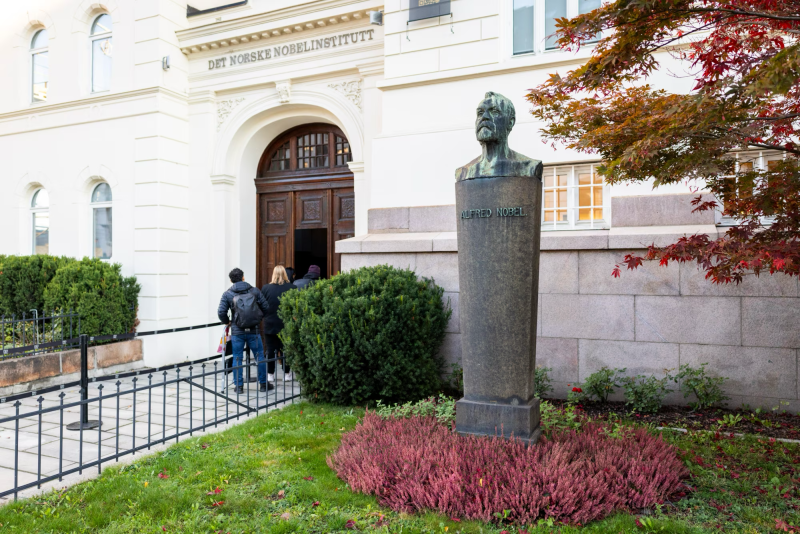
The leader of the Norwegian Nobel Committee made a point, as usual, of justifying how this year’s Peace Prize to Pillay meets the criteria set out by Nobel Prize benefactor Alfred Nobel. It’s been 125 years since the first prize was awarded, and “already then, the Norwegian Nobel Committee underscored the importance of resolving conflicts through international law,” Frydnes said. Navi Pillay, he stressed, also “strengthens” the “fraternity between nations” that Nobel cited in his will that funded the Nobel Peace Prize. She further “provides substance, direction and motivation for peace conferences in their modern form,” Frydnes said.
Most importantly, he added, is that “at a time of existential challenges, including more wars and conflicts than the world has seen in a long time,” international law “is an absolute necessity” yet under “tremendous pressure, and its institutions are under attack.” Without naming names, Frydnes noted that “we see a shift towards power politics at the expense of legal frameworks and global respect for law an justice. Whenever might overtakes right, it undermines stability, trust and peaceful co-existence.”
The Norwegian Nobel Committee, Frydnes noted, “wants to remind the world that the rule of law, national and international, underpins the system we have set up to ensure peace and resolve conflicts non-violently. Peace requires justice.”
There was a total of 287 candidates for the Nobel Peace Prize this year, including 208 individuals and 79 organizations. The prize will be formally awarded to Navi Pillay at the annual Nobel Peace Prize ceremony in Oslo on December 10, the anniversary of Alfred Nobel’s death.
NewsinEnglish.no/Nina Berglund
