

Norwegian defense forces won’t be alone in responding to any national emergency. The country’s statewide police force is also responsible for public safety, and wants a major boost in its own funding to deal with a rash of new threats to both domestic security and energy supplies to the rest of Europe.
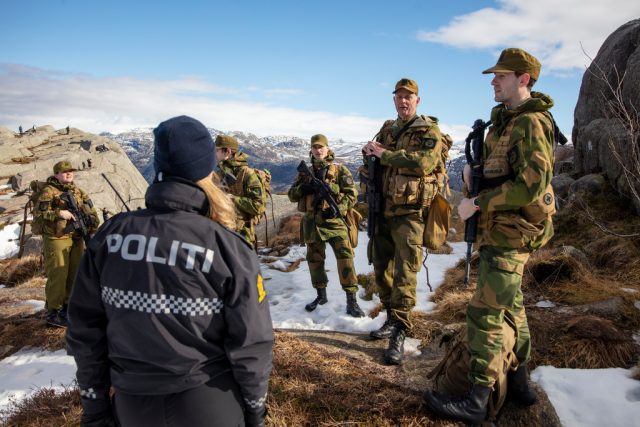
The threats include hacking, sabotage to important infrastructure in their regions and, not least, to all the land-based facilities that export Norwegian gas and electricity. Concerns arose at an annual gathering of police last week that they’re currently unable to meet all their obligations.
That includes border control and surveillance of traffic at sea. Police officials stationed along Norway’s lengthy and busy west coast are especially worried about their ability to monitor it all.
“When it comes to physical monitoring of all ships from outside Schengen (the area encompassing 29 European countries that have abolished control of their common borders) in our police district, we have capacity to control 1 percent,” Nils Petter Kjeilen, leader of the western police district Vest, told newspaper Dagens Næringsliv (DN). Several other police leaders complained of a lack of adequate resources to tackle all the challenges of a much tougher security situation.
The Vest Police District is responsible for 38 municipalities in Vestland County with more than 600,000 residents and lots of visitors at any given time. It’s also home to critical energy infrastructure including oil and gas terminals that can be subjected to sabotage, cable cuts, pipeline disruption, power outages and cyber attacks.
Police inspector Kjetil Rekdal said at the meeting of the police federation Politiets Fellesforbund last week that he and his colleagues have registered as many as 1,100 incidents involving drones, sabotage, unusual ship maneuvers and vandalism around cables and energy supplies since Russia invaded Ukraine three years ago. Around 80 such incidents have occurred so far this year, when the police had only one vessel functioning. “We clearly need more staffing, better equipment and more compentence” to handle all the incidents, Rekdal said.

Kjeilen is also concerned about their observations of up to six ships a day that are believed to be attached to Russia’s so-called “shadow fleet,” foreign-registered vessels used to get around sanctions against Russia. In addition come Russian-registered vessels and vessels with Russian crews. He said that 11,228 Russian citizens were on board vessels sailing along the Vest district’s coastline last year, three times the number sailing off Northern Norway.
“This needs to set off alarms” within the Norwegian government, claimed Dag Inge Ulstein, leader of the Christian Democrats party and a member of the Parliament’s foreign affairs and defense committee. He’s worried about how police are aware of questionable activity in their areas but unable to follow up on it.
“It’s a paradox that defense is getting so much support, while the police aren’t a priority,” Ulstein told DN. He also notes that the police are barely mentioned in the government’s latest preparedness plans, even though they’ll need to play a major role in any national crisis.
Joakim Øren, a state secretary in the Justice Ministry, countered that the government has strengthened police budgets by a total of NOK 6 billion over the past three years and is in the process of seeking more information from the state police directorate about what’s needed now. The directorate will also be asked how it would be able to respond to a worsening security situation, the possibility of armed conflict and even an invasion and occupation of Norway.
“Everyone in Norway should feel safe,” Øren said, arguing that the government has put priority on the police and wants to ensure that they’ll be able to protect “daily life in the entire country.” He said the police also need a new long-term plan and that the government is working on that, too.
NewsinEnglish.no/Nina Berglund
