

An audience spanning many generations paid tribute on Monday to Sverre Anker Ousdal, recognized as of one of Norway’s greatest male actors ever. Ousdal was laid to rest in a nationally televised funeral ceremony in Oslo’s Domkirke (Cathedral). He was 81.

Ousdal’s career spanned six decades and a wide range of theater and film roles, from Ibsen and Shakespeare to Cold War movies to the faceless narrator of Postman Pat, a British animation series for children. According to a count by encyclopedia Store Norske Leksikon, he had more than 70 roles in stage plays and close to 40 in films.
“With the passing of Sverre Anker Ousdal, Norway has lost a giant in both film, TV and theater,” declared Prime Minister Jonas Gahr Støre in a statement following Ousdal’s death on January 3. “It made a deep impression to see him in challenging roles, even after he was marked by illness,” Støre also told news agency NTB.
Ousdal retired in 2014, with the title part of Shakespeare’s King Lear as his last official hurrah at Norway’s National Theater in Oslo. He nevertheless kept on working, and had a major role on the same stage as late as 2024, in Ingmar Bergman’s Jordbærstedet (Wild Strawberries). Ousdal was planning a comeback later this year, in a part as an elderly father written especially for him in a play about fragile family relations.
Ousdal’s high level of activity late in life was remarkable, considering that he lost 90 percent of his eyesight in 2008 after surgery for liver cancer went catastrophically wrong. Recent audiences at an annual outdoors production of Henrik Ibsen’s Peer Gynt experienced Ousdal by his voice only, in dialogue with another well-known Norwegian actor: His son Mads Ousdal. Father and son had shared the stage before, too, in a version of Eugene O’Neill’s Long Day’s Journey into Night in 2000.
Lubna Jaffery, Norway’s minister for culture and equal rights, hailed Sverre Anker Ousdal as one of Norway’s finest actors, who “delivered a lot over many years, on a high artistic level.”
“When he passed away, a collective gasp went through the population of Norway, for he had always been here,” Jaffery told state broadcaster NRK.

Born in 1944, Sverre Anker Ousdal grew up in Flekkefjord on Norway’s southwestern coast. According to his actress colleague and former boss at the National Theater, Ellen Horn, he harbored no dreams of becoming an actor or movie star. But he became one out of sheer coincidence after spending a few years at sea.
“He had gotten his hands on a book called Hva skal du bli (a career guide for youngsters) and discovered that he could get into theater school with no secondary education,” Horn told the celebrity-packed cathedral.
“He got in on his first try, and let’s be thankful for that.”
In Horn’s view, Ousdal was not only a “blessed actor” but also a great storyteller who loved sharing anecdotes like the one above. Another was about his embarassed father, whom Sverre adored, but who reportedly avoided being seen near the theater when it was plastered with portraits of his actor son.
Horn also read a message from Ousdal about the deplorable state of the National Theater building in Oslo, which is slowly falling apart and has been at the core of bitter political battles for years. Horn said he had dictated it to her shortly before his death:
I’m standing in front of the National Theatre, my workplace for 62 years. People say that nothing is happening with this building. That’s wrong. A lot of things have happened. Bricks are falling down on the street, the roof is leaky (…). I look at (the Ibsen statue outside). Tears are running down his face. I look at Bjørnson. He’s a happy boy, right? No, he’s crying, too. I sense a bump in my throat, it seems I’ll start crying, too. Or is it just the rain? Anyway, all this is so sad, I think to myself. And I walk away.
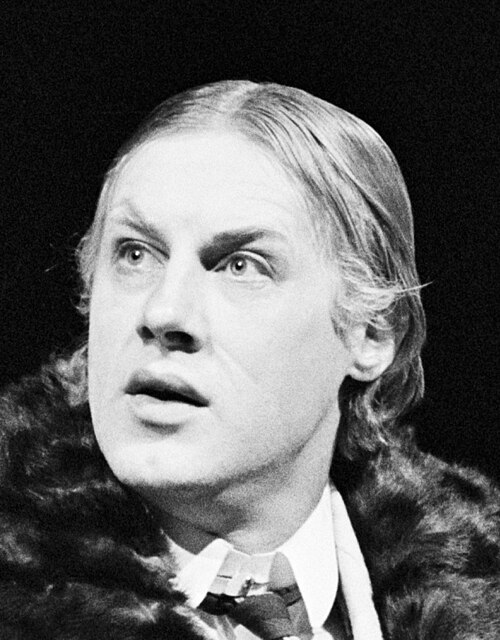
The young Sverre debuted at Bergen’s Den Nationale Scene as an apprentice in 1965. From 1967 he spent three years at Oslo Nye Teater in the capital before joining the National Theater. That professional relationship would last for for the rest of his career and include the complex title roles of Shakespeare’s Macbeth and Ibsen’s Brand. He also had key supporting roles in other Ibsen productions, notably as gloomy outsider types in both of Ibsen’s so-called syphilis plays, A Doll’s House and Ghosts.
On the movie front, Ousdal portrayed all kinds of characters, from Amundsen the explorer to Quisling the traitor. He’s particularly well remembered as a tough guy in the 1985 thriller Orion’s Belt, about three shady businessmen men on a freighter who get entangled in Cold War intrigue in Arctic waters.

He also had unenviable support roles as an unglamourous man, notably in the 1975 comedy Hustruer, about what may happen when three wives decide to go out and behave like their husbands.
A totally different challenge that he tackled was that of Captain von Trapp in a musical version of Sound of Music at Oslo’s Chateau Neuf Arena in 1988. Ousdal probably enjoyed his fictional love affair with the young star Sissel Kyrkjebø as the heroine Maria. But singing the famous but cheesy Edelweiss song was another story: It’s said to be the task in his career that he loathed the most.
In 1997, Ousdal was knighted by King Harald V for his services to Norwegian stage and screen. He also won numerous other honours for his work, including the film industry’s Amanda Award in 1990 and the special Amanda Honours award in 2009. The same year, Norway’s actor association (Norsk Skuespillerforbund) made him an honorary member. In 2024, he and his son Mads were both given the Wenche Foss honour award, named after the popular actress.
NewsinEnglish.no/Morten Møst
