

UPDATED: Stein Erik Hagen revolutionized the Norwegian grocery business with the first “low-priced” RIMI chain in 1977, and went on to become one of Norway’s wealthiest and most socially committed businessmen. He died of a massive heart attack at home in Oslo earlier this month, at the age of 69, and his funeral packed the Norwegian capital’s cathedral last week.
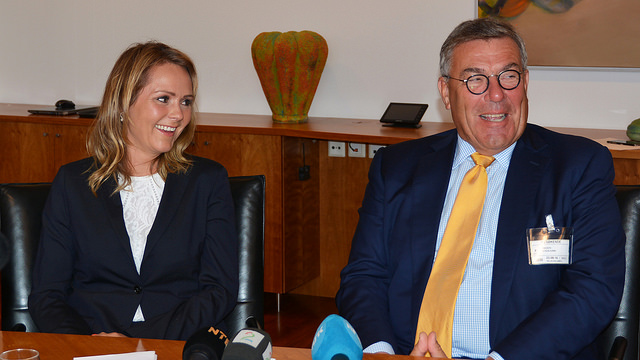
Tributes have poured in since Hagen died suddenly on May 4. His funeral on Thursday was attended by both King Harald and Queen Sonja, their daughter Princess Martha Louise (who’d received a horse as a gift from Hagen when she was competing as an equestrian) and hundreds of top politicians, business executives and financiers, captains of industry and ordinary folks grateful for his introduction of slightly lower food prices in Norway 40 years ago.
All hailed Hagen as an unusually generous billionaire who was active on the arts scene, open about his homosexuality after two marriages to women and happy after finally marrying his husband Bendik Skinningsrud Hagen just last fall. Hagen is survived by four grown children from an earlier marriage, all of whom are involved in the diverse empire he created through investments since selling his RIMI chain.
“We thought papa was immortal, but he wasn’t,” said his oldest son, Carl Erik Hagen, at the funeral. “All of us children had a role in what you’ve left us. We now look forward to take care of what you created for future generations.”
“A pillar has passed away,” declared Nils K Selte, chief executive of the large Norwegian corporation Orkla, in which Hagen owned 25 percent through his investment business Canica. He had held a seat on Orkla’s board since 2004 and led it from 2006.
“Stein Erik Hagen has had an enormous impact on Orkla for 25 years and on Norwegian business for several generations,” Selte wrote in a statement sent to the Oslo Stock Exchange just after Hagen died. “His death was sudden and unexpected. This is a sad day for many in Orkla, and for me personally.”
A press statement sent out by consulting- and public relations firm First House reported that Hagen collapsed at home of heart failure. He received immediate first aid and emergency treatment from health care professionals at the scene, to no avail.
Selte wrote that after more than 30 years of “cooperation in various roles,” he viewed Hagen as “an unusually sharp businessman” who was both warm and generous with those around him. “My thoughts go to his closest family,” Selte wrote.
Hagen started building up his landmark RIMI grocery chain in 1976 and went on to have a long career within retailing, industry, financial investments and management. He became known as “Rimi-Hagen” (as in the Norwegian word for reasonable, rimelig) and the name stuck.

He later sold a third of his chain to major Swedish retailer ICA for more than NOK 500 million and went on to establish the Hakon Group that ended up controlling more than 20 percent of the Norwegian grocery market with its 400 stores in the 1990s and more than 1,150 by 2000. That’s when he sold out to Dutch grocery giant Royal Ahold and earned more billions, while the chain promoted itself as “making Norway cheaper” over complaints from farmers and other food producers who faced new price pressure. Norway remains, meanwhile, known for food prices that are still high by international standards.
Hagen invested his gains in other business projects and moved into the wholesaling side through Orkla, known for its vast array of food- and household products. Canica owns, for example, the Jernia chain of hardware stores, and various real estate projects in addition to a vast art collection. Hagen was also politically involved and known as a major supporter of the Conservative Party.
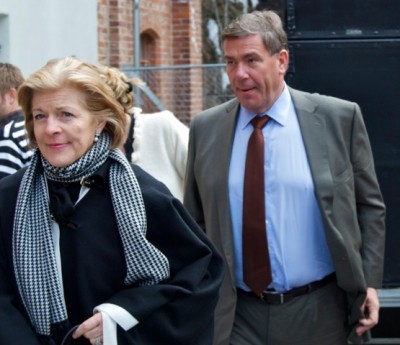
Hagen more recently transferred most of his fortunes and daily managment of Canica and other ventures to his grown children from his first marriage. Hagen was also briefly married to the wealthy heiress Mille-Marie Treschow but they separated and divorced, after which Hagen came out as gay and publicly supported the gay rights movement. He married for the third time just last fall, to Bendik Skinningsrud at the Holmenkollen Chapel in Oslo that’s not far from his vast estate in the hills above Oslo.
Tributes were pouring in quickly after Hagen’s death. Prime Minister Jonas Gahr Støre said Hagen deserves recognition for his contributions to Norwegian business over many years. “The meetings he and I have had have always been good and engaging,” Støre told state broadcaster NRK. “My thoughts go to his closest family.”
Ine Eriksen Søreide, the new leader of Norway’s Conservative Party, expressed gratitude “on behalf of the entire party … for everything Stein Erik has meant for us. He was also a warm and colourful person who was easy to like.” Several party leaders including Søreide attended his funeral.
Søreide’s counterpart at the Progress Party, Sylvi Listhaug, called his death “a sad message to receive. He was a fine person who will be missed. He contributed to creating so many jobs in Norway, and also contributed a lot to medical research.”
Some of that research is tied to Hagen’s earlier diagnosis of prostate cancer that he publicly spoke about. He alerted men to the dangers involved and urged regular check-ups, after receiving advanced treatment himself in the US that’s now available in Norway as well.
Petter Stordalen, another self-made business tycoon in Norway, said Hagen will be remembered as “a warm, clear person with contagious engagement” in his projects. Hagen’s competitors were also stunned by his sudden death, including Odd Reitan who built up the rival REMA chain of discount grocery stores. “There was hard work and tough competition between REMA and RIMI, and lots of fun,” Reitan said. “Stein Erik should have been able to live for many more years, and I’ll miss our conversations.”
Investor and fellow art collector Christian Ringnes called Hagen’s death “a shock and a great tragedy. Stein Erik had so much vitality and power and was in all ways an incredibly generous person.” Ringnes told TV2 that it felt like “one of the forest’s biggest trees has fallen, and I’ll miss him enormously, both as a friend and an inspiration.”
NewsinEnglish.no/Nina Berglund
