

UPDATED: Debate has been flying in Norway over whether the country’s national football squad should be posing as Vikings and “rowing” their way forward in the World Cup. Players, fans and top politicians back home were taking part in the ceremonial rowing, after the Norwegians beat Senegal 3-2 and advanced to the next round, but some supporters don’t like it.
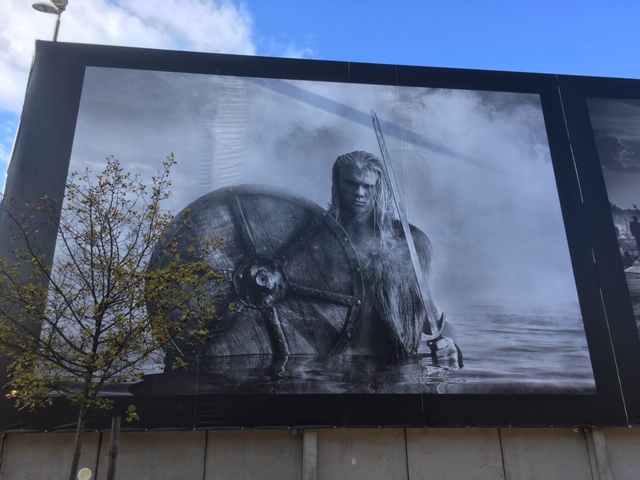
The Norwegian team was dressed for the match against Senegal in the solid black version of their uniforms that also feature Viking-era letters and numbers. Football officials claimed the black uniforms were meant to portray a “Viking mentality” based on “a merciless will to attack,” according to Jan Ove Nystuen of the Norwegian Football Federation (NFF). The uniform, he told news service NTB, is “an expression of something raw, non-compromising and unmistakably Norwegian.”
The black “Viking” uniforms with black stockings also satisfied World Cup officials’ demand that they contrast sharply with those worn by the Norwegians’ opponents, who were dressed in white on Monday night. They also contrast with the Norwegians’ own highly patriotic uniforms featuring the Norwegian flag in red, white and blue.
Critics, meanwhile, object to NFF’s Viking-related marketing campaign (external link to NFF’s website, in Norwegian) and the “brutality” that’s allegedly behind it. “Brutality is not something I connect with things Norwegian,” says Janne Stigen Drangshold, a columnist at the Oslo-based weekly newspaper Morgenbladet, in a recent podcast. “We rather tend to be involved in peace brokering.” All the swords, helmets, shields and other props used in photographer David Yarrow’s new portraits of the team thus seem ironic, in her view.
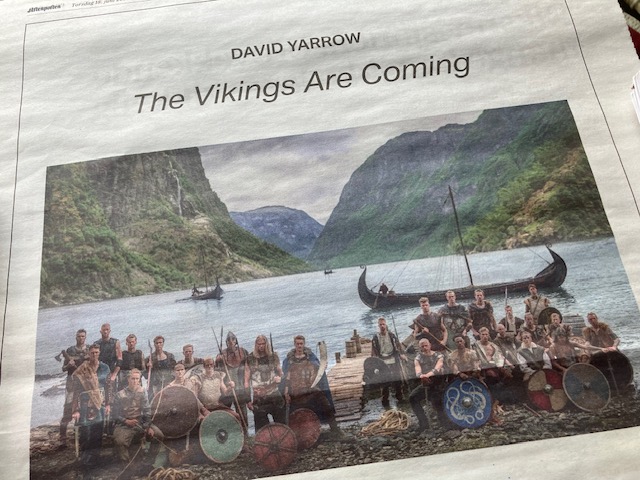
“I think they’ve gone a bit too far,” Drangshold says in the podcast that dwells on the subject of discomfort within culture. She thinks that when the Norwegian national football team is also portrayed with Viking ships, posing for a new assault after rowing across the sea, “they’re rather less inclusive. You wind up with a masculine esthetic and toxic ‘good old boys’ attitude. I think they (NFF) could have found something better.”
Comedian Amir Asgharnejad agreed. “The first thing I thought was, ‘oh no, now they’ve simply put ‘Norway’ and ‘uniform’ into an AI design program that spit out Viking esthetics,” Asgharnejad told newspaper Aftenposten before the World Cup even began. He noted how several ultra-right-wing organizations are also fond of Viking regalia.
“When you’ve been living in Norway for many years, associations to the Viking aren’t just about history,” Asgharnejad said. “Right-wing extremists also use Viking esthetics. I’m not saying that everyone who likes Viking stuff is a right-wing extremist or a nazi, but it does say something about how it’s viewed. They (NFF) could have asked themselves, ‘is this something that unifies us?'”
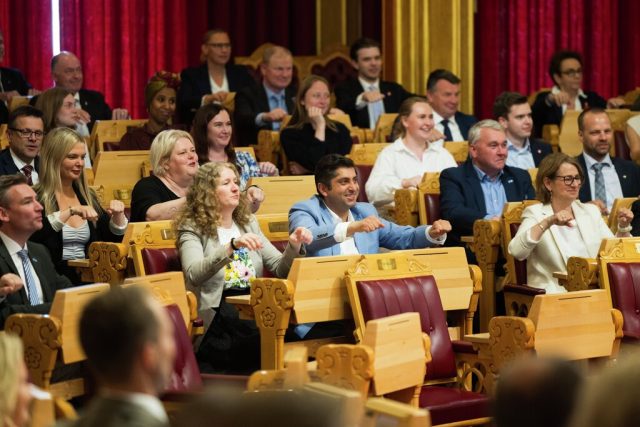
Given all the enthusiastic rowing, not least in Norway’s own Parliament last week, it’s clear that many think it does unify Norwegians behind their football team. On the closing day of this year’s parliamentary session, the legislative body’s president used his gavel to strike the rythym needed for organized rowing, and Members of Parliament played along.
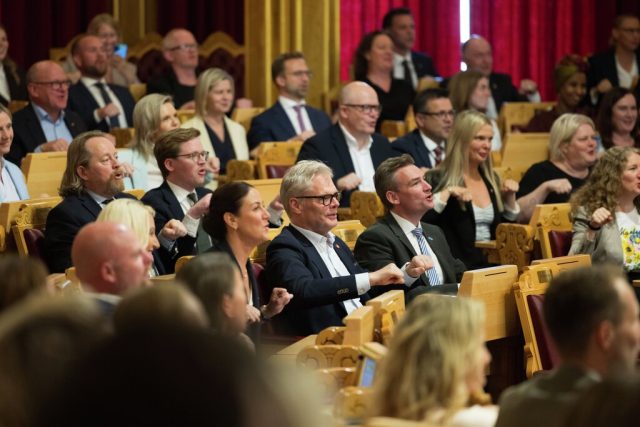
After 10 months of political debate on a wide range of topics, the smiles and cooperation among the MPs was what one of them called the equivalent of “delightfully tacky.” Mimir Kristjánsson of the far left Reds Party didn’t seem to mind any Viking associations to right-wing extremists at all.
“That’s completely misunderstood,” Kristjánsson told Aftenposten. “Claims that (the imitation of Viking rowing) exclude anyone are completely absurd.” He thinks Norway must be able to use its own national symbols, like Viking ships, shields and clothing: “It can be said that not all countries have a very exciting culture, but our culture is both tacky and extreme.” He thinks the national football federation and the team have simply “taken our Viking culture back and are putting a new view on it.”
It’s been confirmed that the football federation also contacted Norway’s national museum devoted to the country’s cultural history before moving forward with their Viking-style marketing and promotion. They wanted to discuss how Viking themes could be used.
Hanne Lovise Aannestad, a Viking archaeologist at the museum, told Aftenposten that the federation was interested in more than just warriors and a willingness to fight. “It wasn’t as if these Norwegian football warriors would slaughter the other teams,” Aannestad said. “It was more about the spirit to travel, strength and collectivity that could lift the team members up and forward.”
Other experts in Viking history, meanwhile, aren’t entirely pleased with the Viking apparel chosen for Yarrow’s photos. Jóhanna Katrin Fridriksdóttir, a researcher at Norway’s National Library, said the Vikings actually preferred “strong colours” including red, green, yellow and blue, and material including wool and linen. She told newspaper Klassekampen that so-called “Viking esthetics, as we view them today, are a mash-up of all kinds of things, and least of all based on actual Viking items discovered.”
Fridriksdóttir stresses that the Vikings as described by their Icelandic contemporary Snorre Sturlason “wore dresses and stockings.” And in a reconstructed Viking suit from Denmark, she notes, “trousers were yellow, the belt was pink and the long shirt was embroidered with plants, animals and links.” It wouldn’t have been big enough, though, to be worn by Norwegian football star Erling Braut Haaland.
The head coach of Norway’s football team, Ståle Solbakken, claimed ignorance over the debate that’s arisen over Viking esthetics and their use by the football federation. “We have many more important and difficult” things to deal with than that, Solbakken said at a press conference last week in the US, which Vikings discovered long before Christopher Columbus. “I can’t spend time on that.” Before his World Cup-bound team left for the US, however, photographer Yarrow had publicly thanked Solbakken for “embracing the idea” of a “departure photo” of the team in Viking garb “from the start.”
Football federation officials, meanwhile, are aware of the controversy around the Viking theme but continue to stress their goal of building up fellowship and team spirit. “We recognized early on that the Viking narrative would be part of how the national team would be perceived,” Ragnhild Ask Connell, NFF’s communications director, wrote in an email to Aftenposten. NFF thus chose “to take ownership” of it and stress “fellowship, shared effort, bravery and the ability to stand together.” Such goals are also attributed to Lise Klaveness, president of NFF, in the federation’s statement attached to the departure photos published only in Norwegian on NFF’s website.
Team members themselves seem to have embraced the rowing antics. After they’d beat Senegal and advanced to further World Cup action, the entire team sat down on the field (external link to state broadcaster NRK’s website, in Norwegian), raised their arms into rowing position and followed the tempo set by team captain Martin Ødegaard in rowing and shouting “ro-ro-ro” (row, row, row) while fans cheered and did the same.
Resistance to the Viking theme and rowing remains, even among ardent fans like Emil Anners Lappen, who sat still in the stadium with his arms crossed on Monday night in Boston while everyone else was “rowing.” He told Norwegian Broadcasting (NRK) that it was a matter of principle.
“This is principle, this is principle,” he told NRK, claiming that the rowing action as a show of support came from Iceland first, not Norway. “We can’t steal from Iceland, steal their idea.” He was referring to how Icelandic football supporters also won international attention during the European Championships in 2016, when they clapped in rythm similar to rowing.
UPDATED: Norway’s third match was against France, the fourth member of Norway’s Group I that had included Senegal and Iraq, which Norway beat by a score of 4-1 earlier last week. France was favoured and ended up beating Norway 4-1, but Norway rebounded in the next round and beat the Ivory Coast on June 30 by a score of 2-1. That led to Norway’s advancement, pitting the Norwegian team against Brazil on Sunday July 5. It was due to be broadcast live on NRK TV and Radio, with the kick-off at 10pm Norwegian time. Brazil was favoured.
NewsinEnglish.no/Nina Berglund
