

It’s that time of year again, when Norwegian peace advocates, researchers and historians publicly speculate over who or what may win this year’s Nobel Peace Prize. An unusual candidate was launched on Tuesday: The International Space Station.
The International Space Station (ISS) is a prime example of cooperation even among rival super powers, according to Haakon Gjerløw, acting director of the Peace Research Institute Oslo known as PRIO. He launched PRIO’s list of five candidates to foreign correspondents in Oslo on Tuesday, and ISS was among them on an updated list.
It replaced the World Trade Organization (WTO) as a peace prize candidate on PRIO’s initial list released last spring. While the WTO is still viewed as a “cornerstone” of a rules-based multilateral trading system, according to PRIO, it’s become painfully clear to WTO members around the world that the current US president isn’t playing by those rules.

“We’re not sure it’s among the best candidates now,” Gjerløw said at the brain-storming session in Oslo, referring to all the controversy over the US’ new punitive tariffs against trading partners. The ISS has instead emerged as an unlikely partnership between American and Soviet diplomats in the midst of the Cold War, that has survived even after Russia later invaded Ukraine.
“For more than 25 years, the ISS has shown that geopolitical rivals can cooperate around a shared, peaceful endeavor, sparking great scientific achievements even when relations on Earth deteriorate,” PRIO researchers wrote in their assessment of Nobel candidates. They added that as the ISS approaches its decommissioning in the early 2030s, outer space is becoming “increasingly crowded, commercialized and potentially weaponized.”
A Nobel Peace Prize for the ISS partnership “would celebrate what humanity can achieve when we work together,” according to PRIO. “We can even hope that a Peace Prize to the ISS and a celebration of the spirit of the Outer Space Treaty can encourage peaceful collaboration with the Chinese and their Tiangong space station.”
Back on earth, PRIO’s Gjerløw and Nobel historians Asle Sveen and Øivind Stenersen shared a few other candidates for this year’s prize. The International Court of Justice and the International Criminal Court were on all their lists, as were nods to the Committee to Protect Journalists and the humanitarian organization Save the Children, with Gjerløw also singling out the work done by the leader of Save Ukraine, Mykola Kuleba. “His work combines direct humanitarian action with strong advocacy for children’s rights, making him a compelling candidate for international recognition,” Gjerløw said.
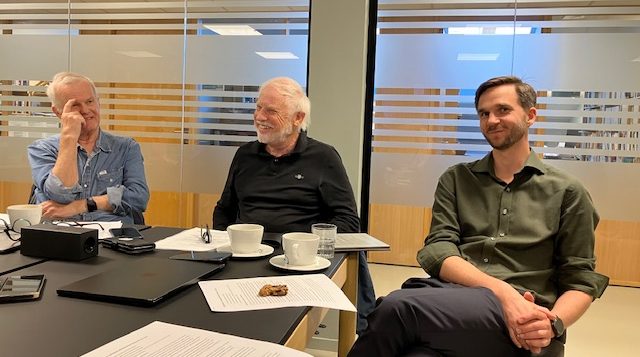
Sveen and Stenersen, who worked together on writing the history of the Nobel Peace Prize when it celebrated its 100th anniversary in 2001, continue to follow the prize’s development closely. Stenersen noted how the prize can inspire, create role models, highlight forgotten conflicts and help those standing up against threats. Stenersen also had Pope Leo on his list of candidates, while both he and Sveen cited Italian legal scholar Francesca Albanese as an “unwavering” expert on human rights through her role as the United Nations’ Special Rapporteur on the occupied Palestinian territories. She has also criticized Norway’s own Oil Fund investments in Israeli firms involved in the war on Gaza, which led to a sell-off in 2025.
Other candidates singled out for the Peace Prize include Sudan’s Emergency Response Rooms, with all three Peace Prize-watchers agreeing they think the winner this year will be of the “non-controversial” sort. Last year’s drama surrounding the Peace Prize to the opposition leader in Venezuela, who later handed over her prize to US President Donald Trump, may prod the Nobel committee into a choice this year that could win more hearts and minds.
One thing was clear among all three Peace Prize watchers: Trump himself will “absolutely not” get the prize he’s been unabashedly wanting for years, claimed Sveen. “I think he has concluded he will never get the prize,” Sveen added.
The winner will be announced, as always, on the Friday of the first full week of October (the 9th this year), and the prize formally awarded in Oslo on December 12, the anniversary of prize benefactor Alfred Nobel’s death.
NewsinEnglish.no/Nina Berglund
