

NEWS ANALYSIS: After two hectic weeks full of political speculation and new signs of public support for the EU, Prime Minister Jonas Gahr Støre could announce that he’ll be forming a new minority government made up strictly of ministers from his own Labour Party. Gone is his former coalition partner, the district-friendly and anti-EU Center Party, which ended up viewing low electricity prices and national control over energy supplies as more important than European cooperation and, claim some, national security.

At issue was whether Norway should adopt a series of EU energy directives (along with many others) that date back to 2018. Both Støre’s government coalition and earlier governments have been slow to act on the directives, since they also raise painful EU membership and sovereignty issues. EU officials’ patience, though, has been wearing thin: Even though Norway is not a member of the EU, it is obliged to adopt most all EU directives under the terms of its economic cooperation with the EU and Norway’s important and lucrative access to the EU’s inner market.
Støre and his Labour Party were and are keen to finally adopt at least three or four of the energy directives. They call for at least 32 percent of energy consumption to be renewable energy by 2030 (Norway already complies with that because of its hydroelectric resources), another involves guidelines for increased energy efficiency and a third directive calls for stricter building regulations to make them more energy efficient and climate friendly. Approval of revised terms for ACER (the EU’s Agency for the Cooperation of Energy Regulators) is also up for ratification: They would give it a bigger role and more authority, not least as an agency for resolving disputes between EU countries.
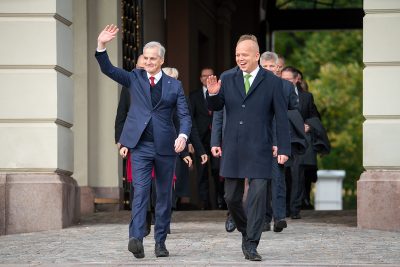
None of that sat well with Norway’s firmly anti-EU Center Party, which largely represents farmers and rural constituents and has a poor record on climate and environmental matters. The Center Party’s leader, Trygve Slagsvold Vedum, emerged from the latest of a string of party meetings Thursday afternoon and said the following: “The prime minister announced that the Labour Party thinks we should move forward with closer ties to the EU’s energy market. My conclusion is that the Center Party doesn’t want to do that.” Vedum went on to say that “we have built up power and hydro-electricity in Norway so that folks in Norway shall have low and stable electricity rates.”
With that, he confirmed that he and his party refused to go along with Støre’s and Labour’s calls to approve the EU directives, likely with support from at least the Conservatives, the Greens and the Liberal parties in Parliament. Around an hour later, Støre held a press conference, at which he confirmed that the Center Party had chosen to pull out of the government coalition he’s led since the last national election in 2021. Støre and his Labour Party will now go it alone with hopes of support from Center on other issues, from the Socialist Left Party (which has supported the coalition on various issues earlier) and from other parties on issues involving foreign affairs, national security, defense and many others.
Støre made it clear that he didn’t want Center to leave the government, and tried to convince them that the EU energy directives “are good for Norway.” So is the need for good relations with the EU. Støre said at the press conference that he also wants to reduce the backlog of other EU directives waiting to be adopted in Norway, “involving lots more than just energy,” but probably didn’t think Center would support that, either. The prime minister insisted that he and Vedum were “parting as friends,” but the parties will now go their own ways in the run-up to the next national election in September.
Political commentators widely viewed the government split as amicable, and a surprisingly bold move on the part of Støre. Both Center and his Labour Party have plummeted in public opinion polls and Støre himself has faced strong opposition within his own party. Tone Sofie Aglen, political commentator for Norwegian Broadcasting (NRK), claimed Støre pulled off a “spectacular” demonstration of power on Thursday, while retaining as much dignity and respect as possible: “What we thought was a weakened Støre ended up getting things exactly as he wants, while the once-powerful Trygve Slagsvold Vedum lost control over his own party.”
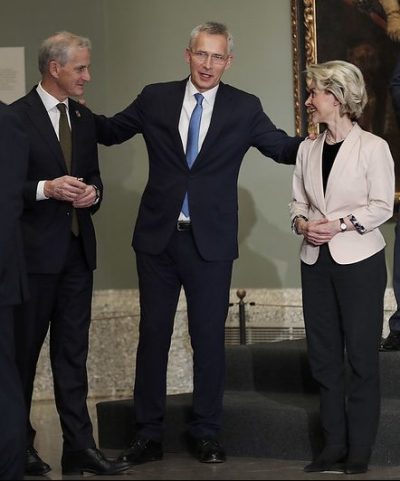
On Thursday Støre suddenly appeared stronger than ever before: cool, calm and collected at his press conference, answering questions with authority and appearing eager to downplay any bad feelings between him and Vedum. Støre, who served as foreign minister during Jens Stoltenberg’s two terms as prime minister, has long been respected for his fluency in several languages, his grip on international affairs and diplomatic skills, but has at times seemed uncomfortable as a Labour leader. Now he’ll not only be able to appoint eight new government ministers from Labour and dozens of state secretaries, he’ll also clear the way for fresh Labour faces in Parliament to replace any of those now heading into government posts.
Those posts are also formidable: Norway will be getting new Labour ministers in charge of finance, defense, justice, agriculture, foreign aid, local governments, children and family issues and research and university affairs. Støre made a point of saying that “the work begins now” and that Labour has “competent and motivated people” ready to take on new assignments right away. Most think Støre already has a list ready of ministerial candidates, with formal appointments expected at a special Council of State with King Harald next week.
Set free from their need for constant compromise, both the Labour and Center parties are now widely expected to gain in the public opinion polls. Some political commentators think Center may win back voters who defected to the right-wing Progress Party, while Labour can gain on perhaps the most important issue tied to the entire drama: Cooperation with the EU, or even joining the EU.
Norway has recently been criticized by EU members for being “greedy” and uncooperative, while profiting on high gas prices. Even Sweden and Denmark, Norway’s closest neighbours, have scolded Norway (or at least its Center Party) for delaying or refusing ratification of EU directives, especially those within the energy sector. “People are shocked” that Norway hadn’t accepted the energy package, Georg Riekeles of the European Policy Centre told news bureau NTB, also over recent calls by Center and Progress to do away with electricity cables to Denmark, or to use Norwegian gas as a bargaining card in energy negotiations.
“That central Norwegian politicans threaten to cut cables or gas exports, and pull the handbrake on the climate campaign, is met with head-shaking in Brussels, Copenhagen, London, Berlin and other European capitals,” Riekeles said. He’s far from alone. Sweden’s energy minister Ebba Busch has joined Danish colleagues at the EU in reacting badly to Norwegian threats of cutting electricity supplies. “That would be an absolute catastrophe,” Busch told NTB.
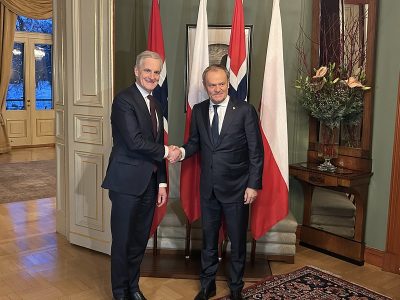
The EU’s energy commissioner Kadri Simson had given Norway a deadline to comply with the EU directives that wasn’t met. Meanwhile accusations rose within the EU that Norway and especially Vedum and his Center Party were acting “egotistically and childlishly” by not going along with the EU directives. Only the Progress Party agreed with Center, but its support stopped there.
Kacper Szulecki, a researcher at Norway’s foreign policy institute NUPI, told newspaper Dagsavisen last week Norway was getting a bad reputation in Brussels and among EU member states: “It’s hard (for them) to understand Norwegians are part of the EU’s inner market but at the same time view the EU as some kind of threat.” Nor do they have much sympathy for Norwegians’ complaints over high electricity rates: “The rates that Norwegians view as ‘extreme’ are actually the (normal) continental European level. So there’s little empathy here, especially given the high gas prices that give Norway advantages at the cost of EU partners.”
Jonas Gahr Støre seems to have understood the frustration with Norway within the EU, especially at a time of war in Europe, threats from Russia and Norway’s desire to become part of the EU’s health union that could help ensure delivery of vaccines in the event of another pandemic. Norway needs allies in addition to those it has in NATO, while the EU is also Norway’s biggest market for seafood, energy and other important exports. Vedum and his Center Party have been more of a liability in Norway’s otherwise multipartisan quest for international partnerships, than an ally.
Even newspaper Dagsavisen, which often sides with farmers’ demands for subsidies, printed a strong editorial calling not only for Center’s withdrawal from the government but for Norway’s inclusion in the EU. “The EU is the most important question of our time,” Dagsavisen editorialized last weekend, especially after Donald Trump took over the US presidency again. “This week’s drama is all about Norway’s place in the EU, and in which direction we should go. Are we better off outside Europe, or does our country’s future lie within the EU, as a full member?” Dagsavisen, which once had strong ties to Labour, called for the latter, claiming that it was “irresponsible” security policy not to debate EU membership: “Our conclusion is a new application for full membership.”
Støre has long agreed, but had to suppress an EU debate while governing with Center. Now he also has “full support” from Norway’s chapters of WWF and Friends of the Earth, the Greens Party and others who noted that the EU’s climate and environmental policy is far superior to Norway’s.
A rash of promotional ads from the pro-EU organization Europabevegelsen have also popped up in Norwegian media lately. “EU phobia threatens our national security,” Paal Frisvold, former leader of the organization and now a Greens politician, wrote in newspaper Dagens Næringsliv (DN) last week. Jonas Gahr Støre and a majority with in his party now seem to agree, openly, with some local chapters demanding that a debate over Norwegian membership in the EU take place as the party’s annual meeting in April.
NewsinEnglish.no/Nina Berglund
