

Kyle Alessandro, an 18-year-old high school student from Steinkjer in Trøndelag, won not only the international jury’s vote at Norwegian Broadcasting (NRK)’s Eurovision qualifier during the weekend, but also the popular vote. Now he aims to win the world’s biggest song contest later this spring.

“We shall win Eurovision, mark my words,” Alessandro exclaimed as he left the stage at Saturday’s nationally televised final in Oslo. “I speak four languages, so we’ll mobilize all of Europe.”
Oddsmakers aren’t so sure, with Norway still stuck down at 26th place on their international odds list of the 37 countries set to compete in Eurovision. Some reviewers of Norway’s songs had also called them søppel (trash), but that didn’t seem to dampen spirits at Saturday night’s show in the Norwegian capital’s arena Oslo Spektrum.
Alessandro said he was overjoyed that he won so many top scores from the 10 international juries monitoring the show in Denmark, Georgia, Luxembourg, Finland, Iceland, Croatia, Australia, Sweden and the UK. Only the jury in Ukraine gave their top score to one of Alessandro’s eight rivals, Nataleen.
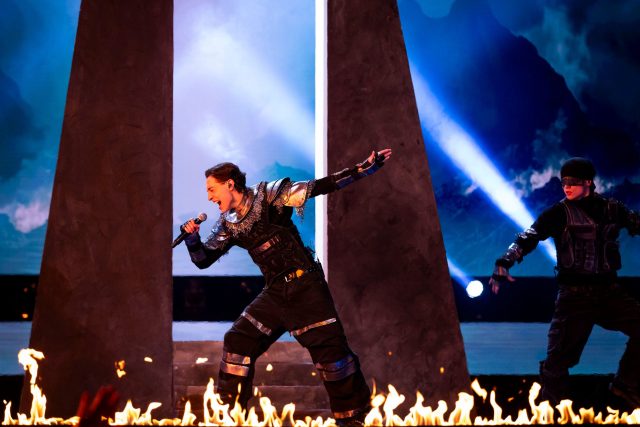
All told Alessandro won 307 points (118 from the juries and 189 from the public). That was fully 117 points ahead of Nataleen, and 142 points ahead of third-place winner Bobbysocks, a female duo who won Eurovision itself back in 1985 with the hit song, La det swinge (Let it swing).
Bobbysocks’ song Joyful was exactly that, and catchy, while Nataleen (Madeleine Nataleen Tverberg from Stokke and Sandefjord, south of Oslo) was won credit for the strength of her voice and the song she wrote with Starlab, The Game. It was Kyle Alessandro’s song Lighter, though, that won the hearts and minds of voters. It’s dedicated to his mother, who has overcome a battle with cancer, and it’s message is about how to tackle tough times.
The song’s message also influenced his costume choice, which resembled a suit of armour. “It helped me to create the energy for my mamma,” he told NRK. “She’s shown a warrior’s soul through her entire ordeal.” He hadn’t had a chance to meet his mother yet after the show, but said “she’s surely very proud.”
Alessandro has competed in the run-up to Eurovision before, in 2023 as part of the group Unami Tsunami. He’s been involved with music since he was a child and also took part in the TV2 program Norske Talenter when he was just 10. He has said he’s inspired by a wide spectrum of musical styles and cultures from South America to Japan and Norway’s own folk music.
This year’s Eurovision qualifier, called Melodi Grand Prix in Norway, was otherwise a slimmed down version of earlier years, which have involved a series of semi-finals around the country that led up to the final. Norway’s contest only involved nine contestants this year, after two dropped out including Angelina Jordan. The former child star now faces compensation claims from NRK, which arranges the show every year.
Saturday’s still-lavish production thus had more time for a special segment that honoured Norwegian songwriter Rolf Løvland, who has written earlier winning songs including Bobbysocks’ La det swinge and the haunting Nocturne, which became an international hit after its debut in 1995. Løvland also has lots of other songs to his credit including the popular You raise me up. His music was in the spotlight at Melodi Grand Prix with versions of his songs performed by the Norwegian artists Sissel Kyrkjebø, Reidun Sæther, Marcus og Martinus and Kim Wigaard.
NewsinEnglish.no/Nina Berglund
