

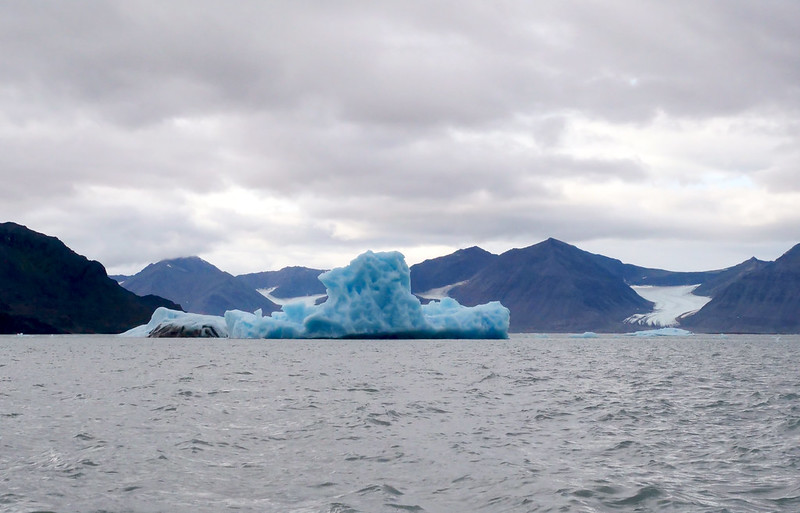
New warnings have been literally pouring in about melting ice on and around Svalbard. It was another record-warm summer for the Arctic archipelago goverened by Norway, with receding glaciers even exposing at least one new island that had been hidden by ice.
“We saw it for the first time around a month ago,” said Geir Moholdt, a researcher at the Norwegian Polar Institute in Tromsø, last week after studying satellite photos. The island has now also been viewed from the air by researchers following walrus movements in the area.
The new island is located off the coast of Svalbard’s largest glacier, Austfonna, in the northeastern portion of the archipelago. Its discovery came just as oceanographers at the Institute of Marine Research (Havforskningsinstituttet) in Bergen were reporting that the waters around Svalbard were three degrees warmer in July this year than normal.
Randi Ingvaldsen, research chief at the Bergen-based institute, noted that the seas around Svalbard are affected much more often by warm marine currents. She noted that some of the world’s fastest and strongest climate change is taking place in the Barents Sea off the coast of Northern Norway.
Four research vessels have been gathering extensive data in the Barents since 2004, and their findings have also revealed contrasts in the seas off Norway. While the waters off southwestern Norway were colder this summer, those around Svalbard set another warmth record. Researchers are also studying the effect of temperature changes on ecosystems in the seas they’re monitoring.
The Polar Institute, meanwhile, reports that climate change is also changing the landscape around Svalbard at a steadily faster rate. Moholdt said the new island in the far northeast emerged from the ice in the late autumn of last year. Now the island is around 400 meters from the edge of the Austfonna glacier.
The institute also believes that the island’s emergence is a result of warmer seas. “The glaciers on Svalbard are in the process of receding up on land,” Moholdt said. “Fjords are becoming longer and in the end, the glaciers will lie only on land.” He said they’ve been losing more than a meter of ice on the surface per year, much more than earlier observed.
For more photos and the institute’s map of the area, click here (external link to the Polar Institute’s website, text in Norwegian).
NewsinEnglish.no/Nina Berglund
