

Oslo’s Airport Express Train, better known as Flytoget, has been one of Norway’s few railroad successes, and popular with passengers. Its future has been under threat from politicians desperate to transfer its capacity and comfort to other deeply troubled lines, but now their unpopular plans may be halted.

Flytoget started serving the Norwegian capital’s international airport at Gardermoen when it opened in 1998. It was Norway’s first and still only high-speed train line, transporting passengers swiftly to and from OSL Gardermoen with a line that now runs to and from Lillestrøm, Oslo, Bærum, Asker and Drammen.
It’s always only served passengers to and from the airport, though, while commuters and other local train passengers still have to use the notoriously unreliable regional lines operated by Vy, the former state-owned rail line NSB. Vy’s trains are packed in the morning and afternoon when they’re not out of service because of chronic signal errors and other technical problems blamed on the state railboard agency Bane NOR.
That prompted Norway’s transport minister from the Labour Party, Jon-Ivar Nygård, to declare nearly two years ago that he wanted to force a merger between Vy and Flytoget, both of which are state-owned. Vy has long tried to compete against Flytoget with its own regularly scheduled line to Eidsvoll, but hasn’t succeeded despite lower ticket prices.
Nygård, backed by the rest of the Labour-Center government, moved forward in September with his proposal to make the successful and long-popular Flytoget a subsidiary of the much-criticized and unpopular Vy. That would allow commuters and other train passengers to hop on a Flytoget train with the same ticket they use for other public transport in the Oslo area.
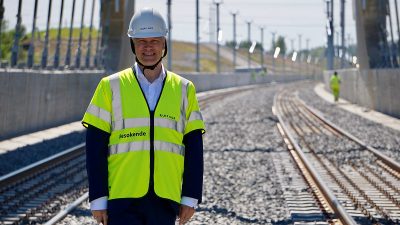
Nygård claimed “everyone who travels by train (in southeastern Norway) would get better service, while the state would get more out of every krone we spend on the railroad.” Lars H Gulbrandsen, representing commuters, also pleaded for Flytoget to “let us on board,” noting how frustrating it is for commuters on packed and often delayed Vy trains to see Flytoget trains whiz past stations with empty seats.
Vy itself, which had trouble competing against Flytoget, launched a campaign to build support for its proposed takeover of Flytoget. It claimed that from 2028, all trains in the Oslo metropolitan area would be open to everyone, including the high-speed routes Flytoget runs. “That will yield far more departures and better capacity,” Vy stated. “Most train passengers don’t need to get to the airport. They need to get to day care centers, morning meetings and sports events.”
Opposition has been strong, not least from Flytoget’s management, which was against the merger, and from many politicians. “Why destroy something that works?” questioned former prime minister Erna Solberg of the Conservative Party, which vowed to halt the merger if her non-socialist colleagues win government power next year. “Norway faces many problems and challenges,” she wrote in newspaper Dagens Næringsliv (DN) in September. “It’s difficult to understand why the (Labour-Center) government makes it a priority to damage something that actually functions well.”
As support for the merger declined in Parliament, business and industry leaders also made their objections known. A former director of the state railroad directorate, Kirsti Slotsvik, called Flytoget “extremely important” for everyone traveling to and from Norway’s gateway airport, “and not least for international travelers.” Others objecting publicly included the national employers’ oganization NHO and tourism organizations.
In October, newspaper Aftenposten reported that railroad regulators also expressed concern about the pending merger: “We think a merger of these two companies (Vy and Flytoget) will weaken future competition in the rail market,” wrote Jernbanetilsynet in a letter to Norway’s competition authority Konkurransetilsynet. “It can therefore be a disadvantage to passengers and society as a whole.”
Last week, just before the Christmas holidays that were marred by enormous train trouble all over the country, the competion authority seemed to agree. Newspaper Dagens Næringsliv (DN) reported that the regulators had found “reasonable grounds” to conclude that a merger of Vy and Flytoget would hinder effective competition, raise ticket prices and lower quality of service.
The competition authority’s “warning” is widely viewed as the first step in halting a merger. It doesn’t mean it’s certain, but it can derail the merger. Transport Minister Nygård told DN he was taking the warning under advisement but still thinks a merger will result in more efficient utilization of rail capacity itself, already at the bursting point.
Now the government needs to convince the regulators that what its political opponents call a new “monopoly” for rail service in the Oslo area is in the public’s best interests. Opposition parties leading in public opinion polls still claim they’ll scrap the proposed merger if they return to government in the fall.
NewsinEnglish.no/Nina Berglund
