

Thousands of Oslo-area commuters, tourists and local residents face major public transport disruptions over the next seven months. They were beginning this weekend, with the first of several closures of metro (T-bane) lines through the busy Majorstuen station.

The closures are all tied to three major projects aimed at eventually improving both public transportation in and around the Norwegian capital and its important station at Majorstuen. The rehabilitation and expansion projects are long overdue, with a new version of the station that dates back more than a hundred years due to reopen in November.
Meanwhile, a new metro line that’s still under construction out to Fornebu, west of Oslo, needs to be connected to Oslo’s existing T-bane system. Called Fornebubanen, it has faced earlier delays and won’t open until 2029, but newspaper Aftenposten reported this week that its tunnel will be connected to Oslo’s T-bane network between now and November.
The third project involves installation of a new signal and electrical system for the metro lines. All of this will disrupt those currently running through Majorstuen, from Kolsås, Østerås and Frognerseteren in the west to Mortensrud, Ellingsrudåsen and Bergkrystallen in the east.

The first transport disruption was set to begin from Saturday, March 22, when the popular Line 1 that currently runs between Frognerseteren in the hills above Oslo and Bergkrystallen in the east will be shortened. It will now run only between Frognerseteren and Helsfyr (another major Oslo transport hub) in the east, with Holmenkollen along the way. Passengers continuing on to Bergkrystallen will be offered substitute bus service.
Some other lines through the city will also be disrupted, along with those from the western suburbs of Kolsås and Østerås. Not all departures will be available and they’re expected to all terminate at the Borgen station just west of Majorstuen.
Passengers can then transfer to more “bus for T-bane” service, or even walk, from Borgen to the Majorstuen area, from which they can connect to other bus- or tram lines through the city. T-bane service is also expected to resume from the Stortinget station downtown and east towards Ellingsrudåsen and Mortensrud.
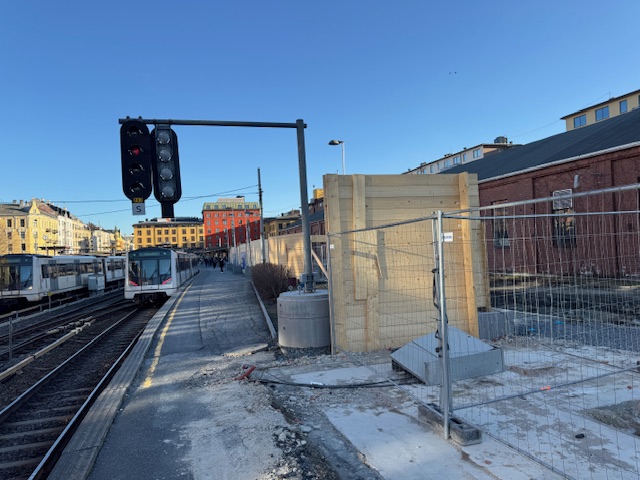
“We hope the public can live with all this for a period,” Øyvind Dahl Johansen, spokesman for the public transport agency Ruter, told Aftenposten. He stressed that when all the work is finished late this autumn, the public including visitors to Oslo will have “much better service” than now, and even better when the new line out to Fornebu opens in four years.
It’s all part of the biggest expansion of the Oslo metropolitan area’s metro system since its original T-bane lines were built out to Oslo’s eastern areas in the 1960s and -70s. Some of the biggest disruptions and closures at Majorstuen itself are due between July 5 and August 10, which is the height of the tourist season but also when commuter traffic is lower because of the summer holidays.
All told there will be as many as 18 significant changes to Oslo’s metro system during the course of this year. Ruter has produced an interactive route map for its metro/T-bane system where passengers can see how the seven months of upgrades will affect lines and traffic at any given time. It’s available on Ruter’s English-language website (external link).
“We’ll do our best to inform passengers clearly and often,” stated Ruter’s managing director Bernt Reitan Jenssen in a press release, “and we hope for patience from our passengers in the meantime.”
NewsinEnglish.no/Nina Berglund
