

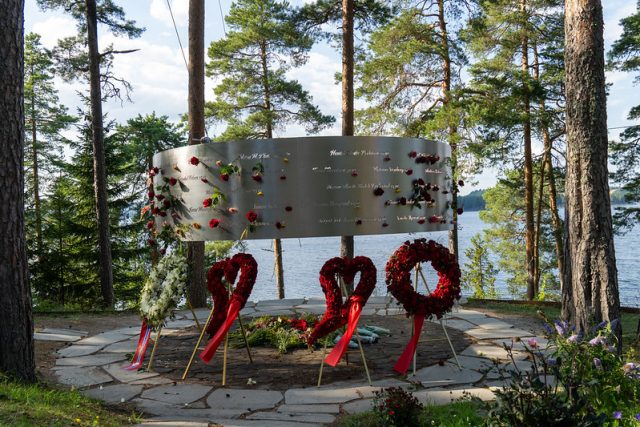
Memorials were held once again this week to honour the 77 people killed in two terrorist attacks in Oslo and on the island of Utøya on July 22, 2011. Lurking in the background, though, were new signs of the racism and hatred behind the attacks, and they’ve been reported to police and security experts.
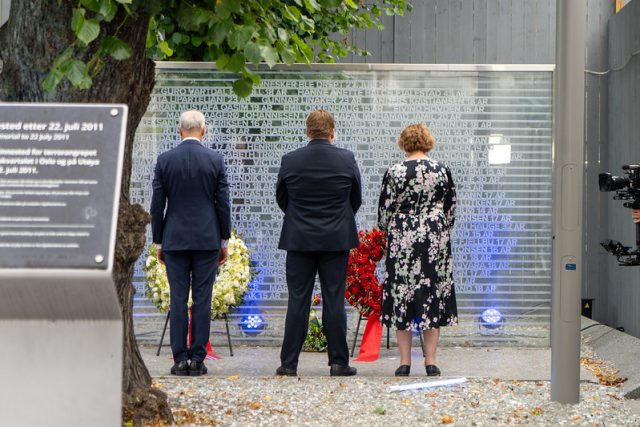
First came news on Tuesday that young politicians in Norway continue to experience online harassment tied to the terrorist attacks 14 years ago. Two members of the organization Socialist Youth told state broadcaster NRk that they were shocked by comments attached to a recent video they’d produced.
The video was taped on the island of Utøya, where the Labour Party’s own youth group has long held its summer camp and where young members of the Socialist Left Party also just held their own camp. Utøya is where the young Norwegian terrorist Anders Behring Breivik, dressed like a police officer, carried out a massacre on July 22, 2011 that killed 69 people, seriously wounded 33 others and terrorized hundreds more. He carried out the attack after bombing the headquarters of the Norwegian government in Oslo that was led by Labour at the time. Eight people were killed there, dozens injured, the government complex was severely damaged and the nation stunned.
When the Socialist Youth published their new video, it was met by comments including “Andy is on the way” and “Anders get of jail” (references to Breivik, who remains in prison in Norway), and drawings of guns, bombs and a call to “get out the rifles.” Amalie Kvernsveen, who worked on the video project, told NRK that “when folks begin to threaten to turn up on Utøya, and hope Anders comes back, that’s going too far.”
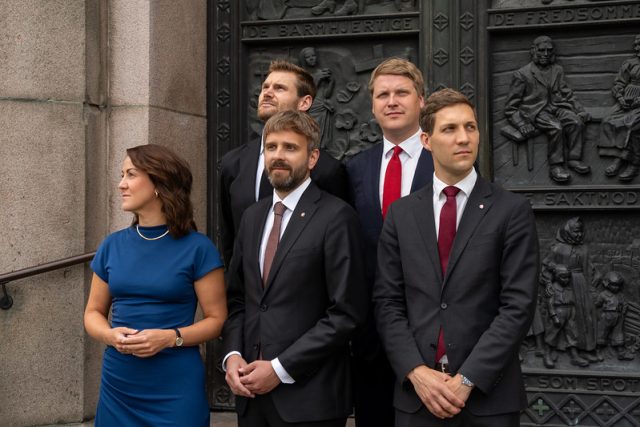
It’s not uncommon, though, to be a target of such virtual hatred. Lena Fahre, director of the July 22 Center in Oslo, told NRK that it’s not unusual for the center to also receive such comments. She added that for the first time since the attacks occurred, the center had to disable comments on its social media because of all the expressions of hatred.
The magnitude of the harassment and hatred against the center on Facebook left her with no other choice. “It was totally unacceptable,” she told NRK, referring to the statements of support for the terrorist and his deadly attacks on the Labour Party because he felt they’d allowed too many immigrants into Norway over the years.
“There was support for Anders Behring Breivik and his attacks that were very alarming,” Fahre said. “It came from both Norwegian and foreign extremists. It was unacceptable and difficult to handle.” Norway’s domestic intelligence agency PST was “oriented” about the harassment, reported NRK, and PST confirmed it was “aware the July 22 Center had received messages they think they had a reason to react to.” PST had no further comment.
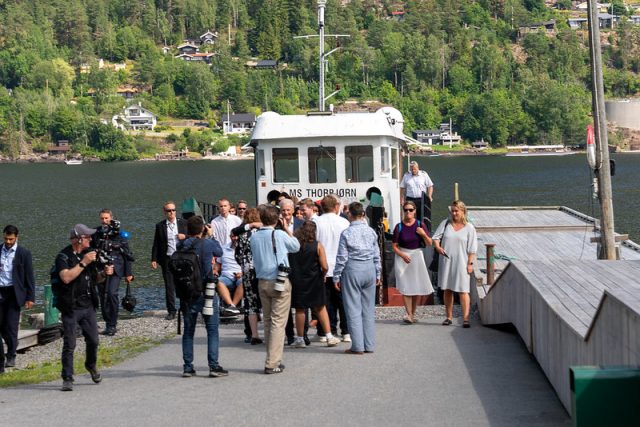
Police in Oslo, meanwhile, are investigating several cases of racist vandalism at the Ekeberg, the grassy plateau in Oslo that hosts the huge Norway Cup youth football tournament every summer. When workers arrived to start rigging up for the event last week, they found a large swastika painted on a playing field and more at a local school. The tournament attracts young players from around the world.
Most have since been washed away and Norway Cup officials said there now are security guards at the site around the clock. “So we hope no one comes back and tries again,” Hanne McBride, communications chief for Norway Cup, told NRK.
Prime Minister Støre, who served as foreign minister when the attacks occurred and lost dozens of party colleagues and friends, remains adamant that the terrorism must never be forgotten and always be condemned. He noted in his remarks that 14 years amounts to “half a generation in our time. A lot has happened in our lives during these 14 years. A lot would have happened in the lives of all those killed on July 22.” He further noted that the government will soon be able to move back into a rebuilt government complex at the site of the bombing.
That may be particularly poignant for the former Labour Party leader who was prime minister at the time, Jens Stoltenberg, who went on to head NATO for 10 years. Stoltenberg always returned to Oslo on July 22, to take part in the memorials. He now serves as finance minister in Støre’s government, which is up for re-election in September, and he spent the hot summer day on Tuesday taking part in all the memorials.
“Regjeringskvartalen (the government complex) is rising again,” Stoltenberg said on Tuesday. The tallest of its buildings, which will once again house the Office of the Prime Minister, is already mostly finished and set to open next year.
“Attitudes create actions,” Stoltenberg said, “that’s why it’s important to build upon the attitudes that counter extremism.”
NewsinEnglish.no/Nina Berglund
