

All five Nordic countries could finally take part in last week’s NATO summit for the first time, and Norway, which was among NATO’s 12 founders back in 1949, is now taking on a new strategic role. It’s no longer alone in being NATO’s “eyes and ears” in the Arctic, and can also provide a new transport corridor for new NATO members Sweden and Finland.
Instead of being an end-station for NATO troops and equipment, Norway will take on a new transport role for new allies Sweden and Finland and enable closer links with NATO’s Baltic members Estonia, Latvia and Lithuania. The Nordic and Baltic NATO allies already got a taste of their new coordinating potential last spring, when the harbour at Narvik in Northern Norway handled 200 vehicles and 300 containers for US troops training in Finland. All the equipment was sent on through and to Sweden and Finland. Norway is taking on new responsibilty for the region known as Nordkalotten, as northern Norwegian ports serve as reception and transit points.
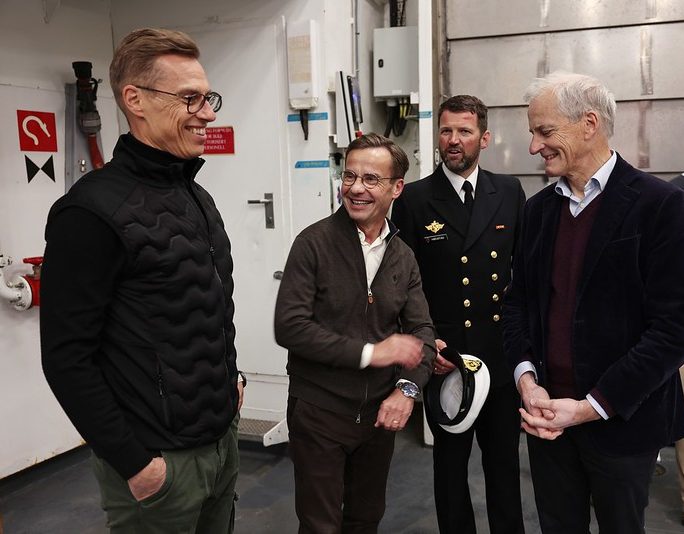
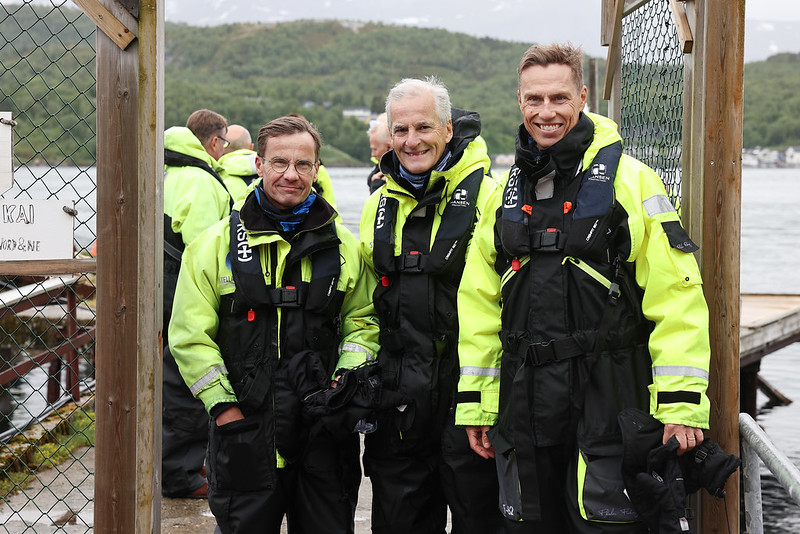
“Norway will play an important role in the defense of Sweden and Finland,” said Norwegian Prime Minister Jonas Gahr Støre when he met with Swedish Prime Minister Ulf Kristersson and Finnish President Alexander Stubb in another northern Norwegian defense hub, Bodø, just before the NATO summit. “And the Nordic countries will play a more important role in the defense of the Baltic, and the Baltic countries.”
Stubb agreed: “If the Baltic area is ever blocked, our only way out will be via Sweden and Norway. These are important discussions here.”
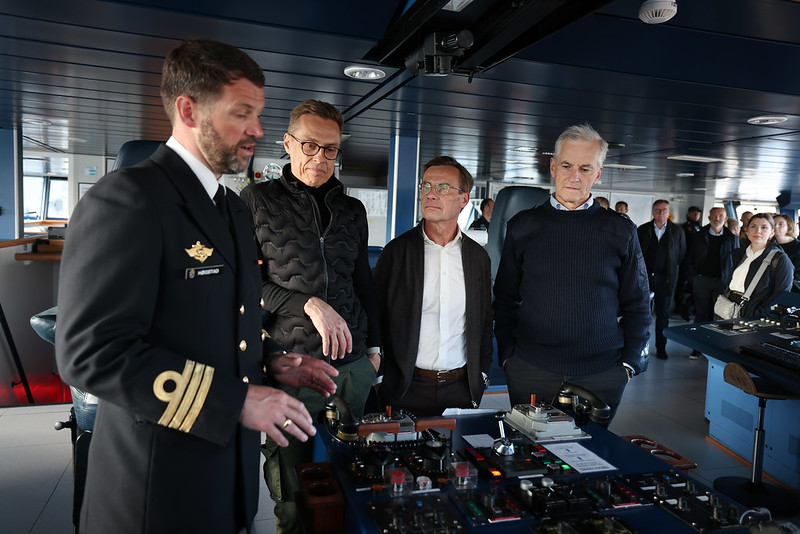
Støre, Kristersson and Stubb will be leading coordination efforts along with civilian leaders to identify bottlenecks and invest in necessary infrastructure to prepare for quick and effective military transport movements. The work has become more important than ever after neighboring Russia shocked the region and the world with its invasion of Ukraine in 2022, which launched the war that’s raged ever since.
With Sweden and Finland now in the same military alliance as Norway, Estonia, Latvia, Lithuania and Denmark, “we can cooperate on defending one another in an entirely new manner, now that we’re all part of NATO,” Støre said during the recent meeting in Bodø.
The new east-west transport cooperation with Sweden and Finland can also finally spark transport improvements within Northern Norway. Roads have long been poor, and as one Swedish official told newspaper Aftenposten earlier this year, “we can’t build a motorway in Sweden if it meets a gravel road on the Norwegian side of the border.” Rail service also needs to be improved and coordinated, to avoid a double-track from one country meeting a single track at the border.
No ‘Nordic Viking Club’
NATO experts, meanwhile, caution against formation of a so-called “Nordic Viking Club” among Norway and its Swedish and Finnish neighbours in the north. NATO doesn’t like blocs within the alliance, if they form at the expense of fellowship with other NATO allies.
“The Nordic countries have been clear that they don’t want to form a Nordic bloc either,” Karsten Friis of the Oslo-based foreign policy institute NUPI told newspaper Dagsavisen. “The Nordic allies don’t, for example, want the Baltic members to feel left out in any way. They’re very conscious of that, even though (the Nordics) will have a joint operative commando center at Norfolk (Virginia) in the US.”
Sweden, meanwhile, is likely to take on a key role in NATO, and is already monitoring Russian naval activity and training hard to protect, for example, Scandinavia’s largest harbour at Gothenburg. Sweden has been defending itself outside of any alliances for the past two centuries, and is highly respected among its new NATO allies.
As Russia continues to attack Ukraine, meanwhile, it’s also been putting up displays of force at sea and in the air in the Nordic area. There’s been an increase in Russian military presence at sea in both the Baltic and Barents seas, open sailing of Russian nuclear submarines at surface level, fighter jets buzzing the coast and alleged jamming of GPS signals in Finnmark. Russia has also held military exercises close to its border to Norway in the far north.
The chief of Finnmark’s defense forces in Northern Norway thinks it’s high time to reconsider Norway’s self-imposed restrictions on military exercises of its own in the area. As of now, Norway doesn’t conduct any military activity exercises east of Lakselv in Porsanger. The rest of of Finnmark extending to the Russian border is guarded, but not used as a site for any NATO exercises.
“In light of today’s situation, I would gladly see a re-evaluation of those restrictions,” Colonel Jørn Qviller told newspaper Klassekampen. He noted that Finland doesn’t have rules for distancing military exercises from Russia: “We have taken part in exercises in Finland, and we trained far east of the area along with the US and other allies.”
The Norwegian Air Force is reportedly working on a plan to spread its new F35 fighter jets in the event of war. Banak Air Station is a possible location, just east of the current dividing line.
Norway is also rebuilding its defense forces after decades of cutbacks when the Cold War was thought to be over. Foreign Minister Espen Barth Eide wrote in newspaper Dagens Næringsliv (DN) this week about how important it is to also bring NATO back to its own territory after all its years of having troops in Afghanistan and other troubled areas. Eide claimed that depleted NATO of “almost all the energy in the alliance,” and the “Euro-Atlantic area” was neglected.
Eide wrote that “it wasn’t wrong to operate outside” NATO’s initial mandate, but the alliance’s core operations needed to “return to center.” Now they are, not least after it became clear that “Russia under (President Vladimir) Putin had develped in an entirely different direction than what many expected during the 1990s.” Last week’s NATO summit cemented the alliance’s return to core operations, now with more allies than ever before.
NewsinEnglish.no/Nina Berglund
