

When Norwegian explorer Thor Heyerdahl visited Rapa Nui (Easter Island) in the 1950s, he conducted months of excavations that revealed thousands of items he was allowed to take back to Norway for further examination. Now many of them are finally being returned to the small island community off the coast of Chile, and they include human remains.

A delegation from the island traveled to Oslo this week to formally receive, for example, a human skull studied as part of Heyerdahl’s attempt to solve some of the mysteries of the island known for its towering sculptures. He’d become fascinated with Rapa Nui after his famous Pacific expedition on the Kon-Tiki raft in 1947.
Now, two decades after Heyerdahl’s death, his granddaughter Liv Heyerdahl has begun the repatriation of many of the roughly 5,600 items brought to Norway. “What happened in the 1950s must be viewed in line with the times,” she told news bureau NTB. She’s now the director of the museum in Oslo that has long had the Kon-Tiki on display along with many other items from her grandfather’s vast collections.
Liv Heyerdahl noted how the items from Rapa Nui were initially sent to Oslo “with permission and with a promise that they one day would be given back.” She conceded that “they could perhaps have been returned sooner,” and some have been, but there were many complications along the way. Now the museum is carrying on an international movement to repatriate museum items.
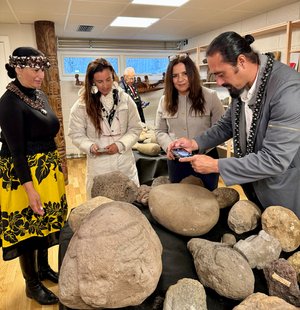
Members of the delegation from Rapa Nui, led by a former governor on the island, also visited King Harald and Queen Sonja, who had visited the island themselves 10 years ago. The repatriation also included an overnight stay by members of the delegation at the museum itself on Oslo’s Bygdøy peninsula, during which they ceremoniously “awakened the spirits” tied to the human remains, spoke to them in their native language, prepared and ate native foods and slept next to them before their journey back to Rapa Nui began.
Another much larger ceremony is planned when the delegation returns to Rapa Nui. Delegation leader Laura Tarita Rapu Alarcón told Norwegian Broadcasting (NRK) that in their culture, it’s important that the human remains of people who lived on the island hundreds of years ago be returned so they can “rest” again. She said that they’ll be met by women wishing them welcome back, and eventually be reburied “for good.” Representatives of the Kon-Tiki Museum were traveling with the delegation back to Rapa Nui.

Liv Heyerdahl said her famous grandfather, who died in 2002, worked actively himself to deliver excavated items back to where they came from. The museum facilitated a smaller repatriation while he was still alive, in 1986, and another in 2006. In 2019, an agreement was signed in Chile, which annexed the island in the late 1800s, during a state visit of King Harald and Queen Sonja. They later made their private visit to the island during the Easter holidays in 2014.
The repatriation launched this week marks the start of a long process. “We hope this will also be a door-opener for ongoing cooperation,” Heyerdahl said. “It’s important that those who own the culture are part of the process. This all feels right, because the items belong to Rapa Nui.”
NewsinEnglish.no/Nina Berglund
