

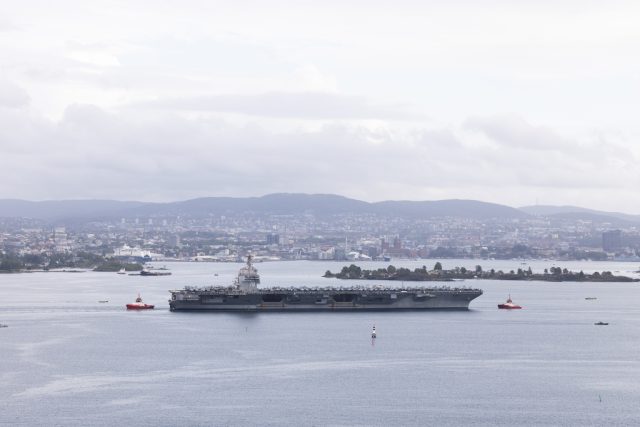
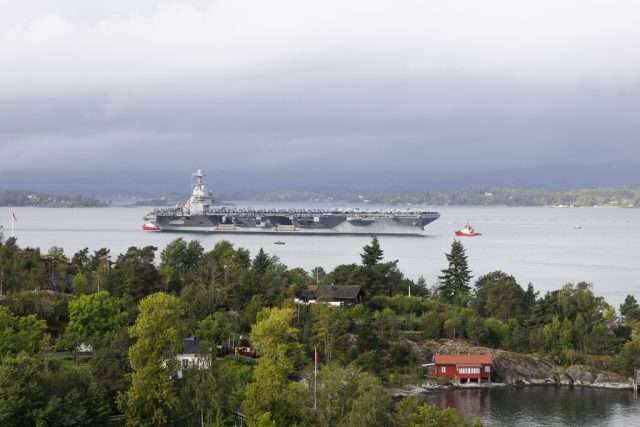
The world’s largest warship sailed up the Oslofjord for the second time in two years on Friday, just after taking part in NATO exercises off Northern Norway. The huge aircraft carrier’s visit also came just days after Russian drones caused trouble in Poland and violated NATO airspace.

The arrival of the USS Gerald R Ford seemed timely, given the latest round of defense concerns in Norway and among other NATO allies that share a border with Russia. The vessel was escorted by the Norwegian frigate KNM Thor Heyerdahl and other naval vessels, while a Bell 412 helicopter from the Special Operations Aviation Squadron hovered overhead.
It was a show of force that also included local police and coast guard vessels, just hours before NATO also announced that it would be strenthening its military presence on its eastern flank in Europe. Dubbed “Eastern Sentry,” the new NATO military operation aims to patrol and control areas along NATO members’ borders to Russia including Poland and the Baltic countries.
Denmark, France, Great Britain, Germany and other NATO members will contribute resources to the operation that was due to begin Friday night, with forces both on the ground and in the air. NATO forces also helped Poland’s own fighter jets in shooting down four of at least 19 drones from Russia. Polish leaders called the drones “a Russian provocation” meant to “test our strength and our ability to respond.”
Norwegian defense forces, meanwhile, have already been setting up a military camp in eastern Poland to help support Polish allies on the ground. Soldiers from the Norwegian Army have been digging trenches, setting up a field hospital, mess hall and other facilities at the so-called “Camp Jomsborg,” begun before the Russian drones landed in Poland.

Norwegian forces have also just taken part in the recent NATO exercises in the Arctic that ran from August 23 to September 8. Both the frigate KNM Thor Heyerdahl and the logistics ship KNM Maud operated in waters between Norway and Svalbard with the group that makes up the Gerald R Ford Carrier Strike Group.
Military officials claimed at a press conference in Oslo on Friday that both the US and Norway benefit from the joint defense operations. “We’re building on the last three years of cooperation with our aircraft carrier forces” off the coast of Norway and in the Arctic, said US Vice Admiral Paul Lanzilotta, adding that the “continual cooperation” had created a “strong and lasting relationship” between the Norwegian and American naval forces.
Norwegian Vice-Admiral Rune Andersen said Norway’s “partnership” with US forces was “tight,” despite changes in American security policy. It’s based, he said, on “common interests in having control in the Northern areas.”
The Kirkenes-based Barents Observer has been following the recent military exercises in the Arctic (external link) and reported that satellite photos showed all three of the Russia’s nuclear submarines attached to Russia’s northern fleet had been sent out to sea from August 25. Russian submarines were reportedly sent out to monitor the US aircraft carrier groups movements in the Norwegian Sea.
British media outlets have also reported that NATO aircraft were out looking for Russian subs near the USS Gerald R Ford‘s group. An American P-8 Poseidon surveillance flight was said to have led the operation, supported by British and Norwegian forces but none of the countries involved has commented. Norway has five P-8 surveillance aicraft based at the Evenes air force base near Narvik.
Now the Russian Navy is carrying out naval exercises of its own in the Arctic, reported the Barents Ovserver on Friday, with photos showing its vessels landing on Franz Josef Land.
Norwegian newspaper Aftenposten editorialized this week that it should become clear to US President Donald Trump that Russia “doesn’t want peace any time soon” as its war against Ukraine drags on after nearly four years. It noted how Russia’s attacks on Ukraine have risen instead of declined, and that Russian President Vladimir Putin, who failed to quickly conquer Ukraine back in in 2022, now seems to be trying to simply wear out the Ukrainians and its supporters.
“Military support to Ukraine must be increased,” Aftenposten editorialized, “and economic sanctions against Russia must be tightened even more.” A US aircraft carrier’s latest call at Oslo on Friday, meanwhile, illustrates how NATO allies are already working much closer together, perhaps more than ever before.
NewsinEnglish.no/Nina Berglund
