

There’s been a new and marked increase in the numbers of Ukrainians arriving in Norway and seeking refuge. Winter is coming and many war-weary Ukrainians are leaving bombed-out homes and apartments that are unliveable, but all face an uncertain future.

“This can be a seasonal variation,” Wenche Fone of Norwegian immigration UDI (Utlendingsdirektoratet) told newspaper Aftenposten. UDI had expected around 6,500 applications for asylum this year, but the number passed 8,300 last month. Expectations have since risen to as many as 12,000 new arrivals from Ukraine by the end of the year.
The numbers of Ukrainians arriving in Norway had been sinking, after Norway and several other European countries tightened requirements for asylum. Young men able to fight in Russia’s war on Ukraine are no longer eligible for the “collective protection” granted earlier, and residents of some areas of Ukrained deemed “safe” aren’t eligible either. Nor are Ukrainians allowed to travel home for a visit – those leaving Norway may not be allowed back in.
Now the numbers of Ukrainians fleeing their homeland are rising again. Fone of UDI said arrivals and applications have exceeded predictions throughout the autumn, in line with Russia’s attacks on Ukraine. “Our prognosis showed an expected increase in arrivals this fall, when many Ukrainians are planning for the winter,” she told Aftenposten.
The rise in Russian bombing raids, now often on the Ukrainian capital of Kyiv and its surrounding area, have not only killed and wounded scores of civilians but also left homes severely damaged. Many Ukrainians live in large residential buildings that have been bombed and are difficult to live in when individual units are cold and dark, and lack water or electricity or both.
“There are of course concerns of an incredibly difficult winter coming,” researcher Oleksandra Deineko at Norway’s Institute for Defense Studies and Oslo Met told Aftenposten. “Ukraine doesn’t have missiles to shoot down balistic missiles. That means people view themselves as living targets without protection.”
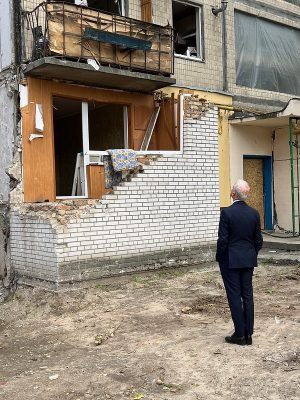
Deineko thinks many Ukrainians “are trying to find a place where they can spend the winter. Some have relatives or friends (elsewhere in Ukraine) where they can stay, but those who don’t have that (others who can take them in) try to leave the country.” In other cases, Russia’s recent bombing raids have even targeted a school, and more than 50 civilians were killed.
Ukrainians are able to reside in most areas of Europe (countries that are part of the so-called “Schengen” region that includes Norway) for up to three months. That can allow many to at least escape the worst part of the winter and return to Ukraine in early spring.
It’s also possible to apply for temporary residence under the so-called “collective protection” clauses, or for asylum and permanent residence. More than 600 of those recently arriving in Norway have opted for the latter, even though they face a long approval process that’s become more difficult and increases uncertainty for families and especially their children.
Current proposals call for changing the “collective protection” from five to seven years, with the prospect for permanent residence extended by two years. That means Ukrainians may need to wait for as long as nine years in Norway before they can apply for permanent residence. Refugees from other countries who are granted individual protection can seek permanent residence after five years.
One Ukrainian couple with two children, the youngest born in Norway, recently wrote in newspaper Dagsavisen about how their uncertainty over the future can be even harder on children growing up in Norway. Those arriving as toddlers right after the invasion are already seven or eight years old, have started school in Norway and speak Norwegian. Many don’t remember their lives in Ukraine, and Ukrainian children born after their parents arrived view Norway as their homeland.
“‘Where’s my home, what happens now?’ asks our eight-year-old son,” wrote Kateryna Pauchenko. “The truth is that I don’t know myself, whether he’ll be able to go to the same school and have the same friends next year.” She stressed that the family is grateful to Norway for taking them in when they had to flee in 2022. At first they thought they’d be able to seek permanent residence after three years like most others moving to Norway, but that was changed to five years, then to seven and now possibly to nine years.
“We’re not against protection being extended,” she wrote, “but we’re against the price children have to pay for that (if they and their family are suddenly sent out of the country when they’re young teenagers).” Pauchenko hopes the years Ukrainians have spent in Norway with legal residence can count towards permanent residence on the same terms as for other immigrants. She fears the price Ukrainian children may have to pay will be very high, in terms of sheer uncertainty over their own lives.
Ukrainian officials, meanwhile, have reported that more than 19,000 Ukrainian civilians have been killed since Russia invaded in February 2022. Among them are nearly 800 children, prompting the new waves of Ukrainians arriving every day.
NewsinEnglish.no/Nina Berglund
