

Just as Norwegian Prime Minister Jonas Gahr Støre entered into a new “strategic partnership” with his British “neighbour” Keir Starmer on Monday, he faced a storm of criticism from much closer neighbours in Sweden. Støre’s Labour Party also remains caught in a storm of its own, after public opinion polls have crashed and its administrative leader Kjersti Stenseng announced she’ll be leaving her post.
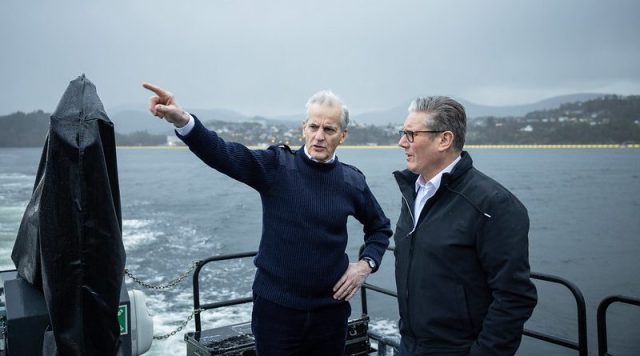
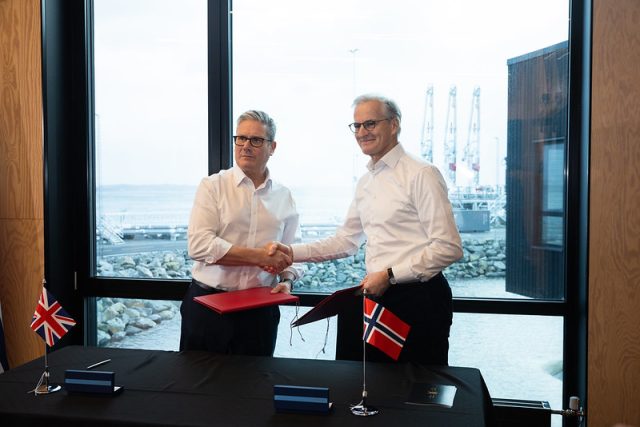
Strong winds and storms in Western Norway seemed to reflect all the trouble Støre is in as he hosted his British guest in Bergen on Monday. Støre stressed how the UK “is one of Norway’s most important allies,” and in “challenging times,” their new partnership is meant “to safeguard common interests” within “defense and security, energy and the green transition.”
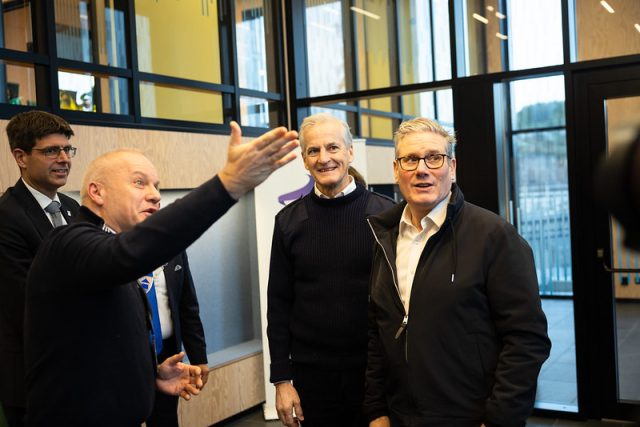
Details of the partnership emerged in a “joint declaration” (external link to the Norwegian government’s website) published as Støre and Starmer met and were joined at one point by the chief executive of Norway’s state oil, gas and energy company Equinor, Anders Opedal. Equinor and Shell recently announced that they’re teaming up in the UK, while Equinor has been trying hard to tone down its fossil fuel image and explain why it’s taking so much time to cut emissions and make the transition to more climate-friendly sources of energy.
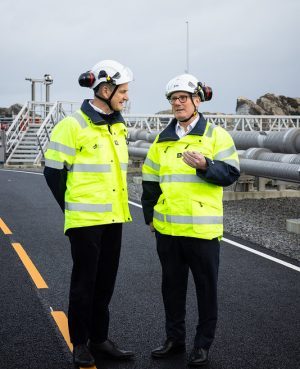
Opedal was along on Monday for the prime ministers’ visit to Norway’s new facility for the transport and storage of carbon dioxide at Øygarden, just west of Bergen. Equinor is also working on projects with British oil firm BP on the UK’s own carbon capture and storage facilites, while also launching wind power projects off the coasts of the US, England and Poland.
As Støre’s government highlighted the importance of such energy cooperation on Monday, though, it was being accused of all but sabotaging it with otherwise allied government officials in neighouring Sweden and the rest of the EU. Støre’s Labour Party and his coalition partner, the Center Party, stated last week that they don’t want to maintain two of Norway’s electricity cables to Denmark, complaining that the energy they send to Europe contributes to higher electricity rates in Norway.
“That will be a complete catastrophe,” declared Sweden’s government minister in charge of energy issues on Monday, Ebba Busch. She told news bureau NTB that cutting off the cables will hurt not only Denmark but also Sweden and Poland, and have an effect “on the entire energy system in Europe.”
She’s not the first to complain about the Støre government’s proposal to eventually curtail the electricity it sends to Europe through its participation in an integrated market. Norway’s Center Party has always opposed sharing Norway’s abundant hydro-electric resources that historically kept electricity rates low at home. Center has a record of resisting other market forces as well, favouring protectionistic policy especially for Norwegian farmers.
While Støre described the UK and Norway as “close neighbours” separated only by the North Sea, Sweden and Norway share a long border and have recently become allies in NATO as well. It makes news when one country’s leaders openly criticize the other’s, as Busch did on Monday.
She’s far from alone, as other countries within the EU exhibit a rising tendency to view Norway as a wealthy non-member known for acting in its own interests. Brexit made the UK a non-member, too, which can explain why Norway and the UK are eager to team up when they can.
Media commentators in Norway, however, have been warning recently that Norwegian politicians need to be more careful about offending their own allies. Sweden is also angry with Norway over new fishing quota proposals that can cut off its access to herring stocks in the North Sea and Skagerrak. Norway struck a deal with the EU that can hurt an EU member like Sweden. “Norway always wants more and more of its ‘own’ waters,” Swedish fisheries minister Peter Kullgren told NTB last week. “We’ve had problematic negotiations for a long time, but it’s in fact exceptionally bad this time.”
Commentator Kjetil B Alstadheim, political editor of newspaper Aftenposten, is among those warning Norwegian government officials against being too demanding, and against too much whining of their own. “Who feels sorry for Norwegians?” he wrote over the weekend. “Hardly very many.”
Norway has profited greatly on its gas supplies to Europe and other aspects of Russia’s war on Ukraine, and should be careful about reducing any electricity supplies now. Yet there are several areas, wrote Alstadheim, where Norway is irritating the EU even at a time when interest is rising among Norwegians for a new national debate on EU membership themselves. Alstadheim further noted once again how Sweden played a key role in sharing the EU’s vaccine supplies with Norway during the pandemic. Swedish ministers like Kullgren and Busch can’t see much gratitude now.
Støre, meanwhile, remains plagued by miserable standings in public opinion polls, calls for his resignation as leader of the Norwegian Labour Party and what some commentators call either an “attempted coup” or simply a revolution within the party. Aftenposten reported late last week that at least four of Labour’s county coalitions claimed during a recent telephone meeting that Støre should step down.
On Sunday, Labour Party Secretary Kjersti Stenseng did just that herself. She announced she will resign her post this spring, less than half-a-year before the national election in September.

“I think some renewal can be good for the party,” she told Aftenposten on Sunday, adding that “some new energy is needed.” She denied she had been pressured to resign, especially since Labour claimed around 40 percent of the vote when she took over as party secretary in 2015 and now has less than 15 percent.
Stenseng refused to say whether she’s among those who think Støre himself should step down as party leader and, thus, Labour’s candidate for prime minister. If current polls were election results, his Labour-Center government would lose badly, and clear the way for a new right-wing majority government formed by just the Progress- and Conservative parties.
“We have two competent deputy leaders, who are good and have lots of energy,” Stenseng said. “But I think more is needed than just shifting people around.” She thinks the party’s politics need an overhaul as well.
NewsinEnglish.no/Nina Berglund
