

After years of planning and millions of kroner worth of initial costs, the incumbent Norwegian government has now dropped an ambitious ship-tunnel project from the state budget it will present next week. Actual building costs have soared, and Prime Minister Jonas Gahr Støre has determined that building a ship tunnel along Norway’s west coast is simply too expensive.
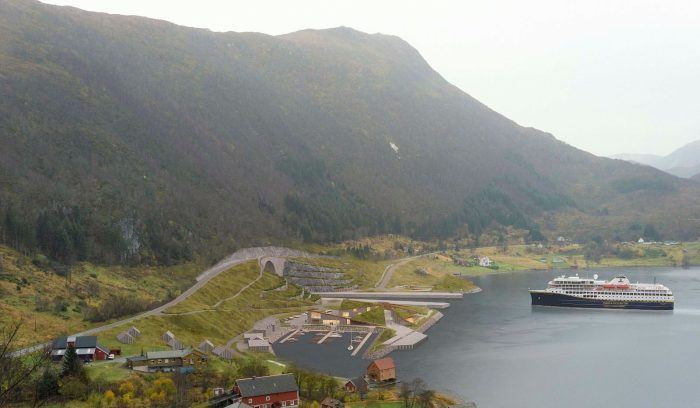
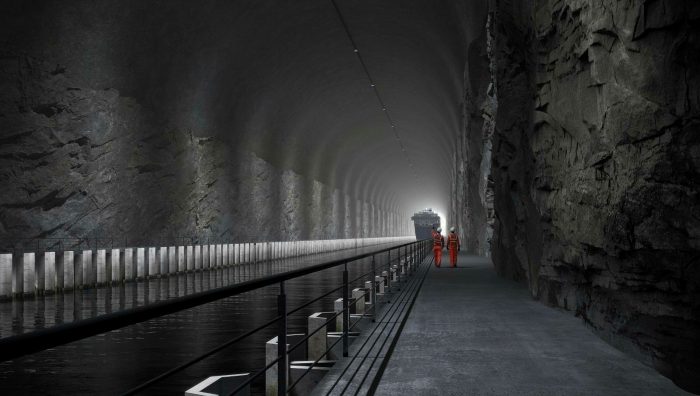
As reported back in 2013, the idea of a tunnel from the Moldefjord to the Kjødefjord at the narrowest and farthest inland portion of the infamous Stad peninsula was first launched as far back as 1874. The most recently proposed 1,800-meter-long tunnel was meant to accommodate ships as large as the Hurtigruten cruise-ferries that ply the coast between Bergen and Kirkenes. Its total cost at the time was estimated at NOK 1.5 billion.
Then it rose rose to more than NOK 3 billion, when it was also dropped out of the Støre government’s first full state budget proposal in 2022. The Parliament set a maximum cost level for the ship tunnel at NOK 5 billion, but by 2023 the state coastal agency in charge of the project, Kystverket, reported that costs had reached NOK 7.1 billion. That meant every ship that could squeeze through it (the maximum vessel size were those for by the coastal voyage ships in the Hurtigruten and Havila lines) would likely need to pay NOK 52,000 (USD 5,200) to sail through it. Every day.
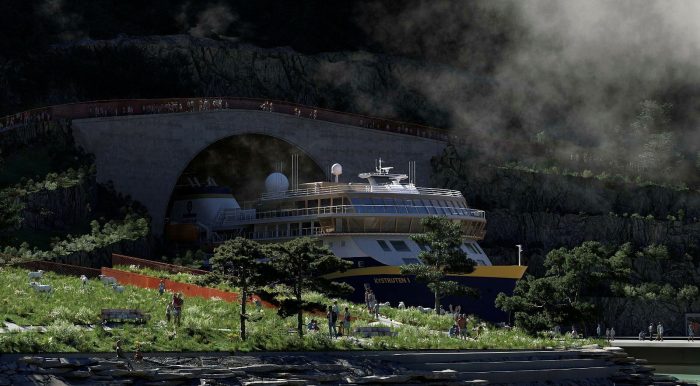
The expensive and unusual project, which has grabbed quite a bit of international attention over the years, remained popular, however, especially in the area where it would be built. Its main goal was to make it possible for many vessels to avoid sailing around what’s called Stadlandet and its West Cape, the treacherous most westerly point of Norway. It’s known for dangerous and sometimes deadly storms that have resulted in shipwrecks for centuries.
The project was also expected to create jobs and economic development where it would be built. It continued to be studied and drafted, and actual building time was set at five years. When its expected budget recently rose again, to NOK 9.4 billion, though, new uncertainty set in.
On Friday morning, Prime Minister Støre confirmed to Norwegian Broadcasting (NRK) that he was dropping the project from his new proposed state budget “and we’re ending work on the Stad ship tunnel.” He said his government could no longer justify its costs at a time when Norway faces other major costs for defense, health care and the services provided by local governments.
“We have to prioritize, and get the most out of every krone in order to use the money we have most efficiently,” Støre told NRK. “Therefore we’re saying ‘no’ to this project, because we can’t defend such major costs.” He defended all the money that’s been spent on the project so far, saying it was an “interesting and exciting project,” especially, perhaps, when he had to placate his government partner at the time, the Center Party, that supported it.
Center left his government last winter, though, and Støre doesn’t need to compromise with it as much any longer. “At some point a government needs to make a decision,” Støre told NRK. He now thinks it would “irresponsible” to keep spending even more money on a ship tunnel.
Støre has support at least from newspaper Aftenposten, which editorialized in early September that “the world’s largest ship tunnel should remain a dream.” The paper agreed that despite fairly broad political support for the project in Parliament (only the Greens were against it at one point), the costs seemed to keep rising out of control. An albeit reluctant Progress Party and others are also more skeptical to the higher costs, while several studies have indicated it wasn’t viable from a social economic point of view.
There have also been fewer serious maritime accidents around Stad in recent years, and there was no guarantee ships including Hurtigruten would use it. Russia’s war on Ukraine has also set off off a huge rise in defense spending that didn’t exist when the projecty was first introduced.
The rural-oriented Center Party was already complaining bitterly Friday afternoon, calling it one of the biggest “broken promises” of all time. It could only claim 5.6 percent of the vote in the last election, though, so lacks clout, but Labour’s own local politicians were unhappy as well. They were already calling for compensation to be paid for those who’ve had to sell property needed for a project that most likely won’t be built.
Finance Minister Jens Stoltenberg will be presenting the government’s proposed state budget on Wednesday. The ship tunnel’s fate will ultimately be decided along with it.
NewsinEnglish.no/Nina Berglund
