

NEWS ANALYSIS: The US Embassy in Oslo has long been mocked as “Fortress America,” both when it was located in the heart of the Norwegian capital and when it moved to a much larger site in a mostly residential area. Neighbours protested the move for years, viewing it as a security threat, and in the middle of the night their worst fears were realized.
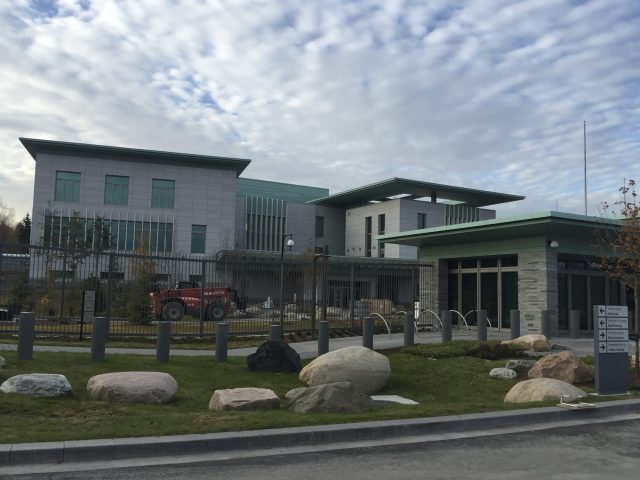
“I sat and watched TV when there came an explosion and the whole house shook,” one local resident told newspaper VG. Others told VG they were awakened by the explosion, described by one as “really powerful. We also saw a lot of smoke coming from the embassy.”
Police responded quickly to the blast, which occurred around 1am on Sunday outside the consular section of the embassy. It’s located on the right side of the sprawling embassy complex that’s completely fenced in and reinforced by pillars meant to fend off any car bombers.
The entrance to the consular section is the only one open to the public in general, and security procedures there are strict. American citizens who need to renew passports, Norwegians seeking visas and others who need embassy services must have an appointment. Even with that, they still must wait in line outdoors before being allowed into the entry area for its screening procedures. Only then can they finally proceed to the building where consular staff work from behind a glassed-in counter.
Reports from the site Sunday morning initially described damage as minimal, with only some broken glass and window frames seemingly out of place. There was also broken glass outside the embassy fence and officials later said damage was more extensive, without going into detail.
At a mid-day press briefing, investigation leader Frode Larsen hesitated to describe the attack as an act of terrorism, telling state broadcaster NRK that “there can be other reasons for what happened.” Both Larsen and Grete Lien Metlid of the Oslo Police District said at and after the press briefing, however, that it was “natural” to view the blast “in connection with the current security police situation,” referring to the US- and Israeli attacks on Iran and the new war in the Middle East.

Police at the site described what they called the “incident” as “a loud bang/explosion,” and responded with “major resources” around 1am. They didn’t initially use the word “bomb” and said actual damage was minor. Police said embassy staff reported no injuries among those on duty, believed to be few since the embassy was closed for the weekend.
Oslo police nonetheless responded with full force, calling in extra personnel throughout the night. They summoned a police helicopter, quickly mobilized their “bomb group” and crime technicians, and blocked off large area around the embassy that VG reported as spread over a radius of 700 meters. Heavily armed police with dogs patrolled the area, which included major portions of the local neighbourhoods known as Huseby along with parts of Montebello and Smestad. Police also used drones in the search for suspects.
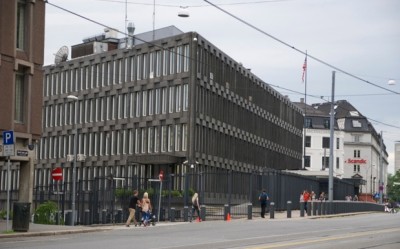
The main road running through the area (Sørkedalsveien) was closed for the rest of the night, but reopened Sunday morning. Police also reportedly stopped cars that had driven down the nearby road from Holmenkollen, as their search for those behind the explosion continued. Norway’s police intelligence agency PST has also confirmed that it’s joining the investigation.
Justice Minister Astri Aas-Hansen of the Labour Party issued a statement condemning the explosion as “an unacceptable incident” that was being taken very seriously. She’s in charge of Norway’s state police and court system, and said police were “investigating the case with large resources.”
She also claimed that “nothing indicated the situation is dangerous” for those outside the embassy, but neighbours may disagree. An explosion of other form of attack on the US Embassy is exactly why they fought against its relocation from downtown to Huseby.
There are ironies around Sunday’s explosion, meanwhile. Its timing, just a week after US President Donald Trump ordered an attack on Iran in cooperation with Israel, can suggest that whoever attacked the embassy is angry with the Trump Administration. If so, they’d be joining many others already angry with Trump over a long list of other issues.
Yet Trump hasn’t appointed any new ambassador to Norway, more than a year after he took office, and thus has no personal representative in the country. The embassy is currently run by career diplomat Eric Meyer as “interim Chargé d’Affaires,” who thus has no direct political ties to the Trump Administration.
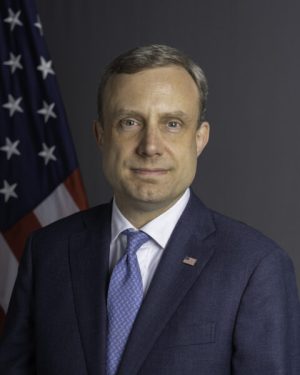
On the contrary, Meyer is a multi-lingual career member of the Senior Foreign Service made up of professional diplomats, a group for whom Trump has shown remarkably little respect. Trump has often been accused of carrying out his own form of deal-making instead of diplomacy, creating frustration and distress for the US State Department’s ranks.
Meyer is relatively new in Oslo, arriving after serving from January to August last year as chief of the Bureau of South and Central Asia Affairs, where according to the embassy he “led efforts to coordinate US policy priorities throughout South and Central Asia.” As Chargé d’Affaires at US Embassy in Norway, he “oversses operations and policy implementation at both the US Embassy in Oslo and what the embassy calls its “American Presence Post” in Tromsø, the “only US diplomatic post in the Arctic.” Meyer, meanwhile, is a graduate of the University of California at Berkeley (where Norway’s Crown Prince Haakon also studied) and earned an MBA from Georgetown University in Washington DC.
The embassy itself hadn’t posted any reports or alerts tied to the explosion as of mid-morning and its “Norway Travel Advisory” level remained at its lowest level, advising American citizens in Norway to merely “exercise normal precautions.”
Both Justice Minister Aas-Hansen and Foreign Minister Espen Barth Eide told VG they’d been in contact with Meyer. “The security of all diplomatic stations (in Norway) is extremely important for us,” Eide told VG, adding that the attack on the US Embassy “is being investigated by both the police and PST.” The security agency’s own threat evaluation for Norway, meanwhile, remains unchanged.
Police repeated later in the morning that the attack on the embassy has “high priority” and that the search for those behind it was well underway. Police at the scene have said they “have an idea” of what was behind the attack and what was used, but didn’t want to elaborate.
NewsinEnglish.no/Nina Berglund
