

UPDATED: All nine political parties in the Norwegian Parliament pulled together on Thursday to address what Prime Minister Jonas Gahr Støre had earlier in the day called “the most serious security policy situation since World War II.” They all agreed to more than double military and humanitarian aid to Ukraine in this year’s state budget.
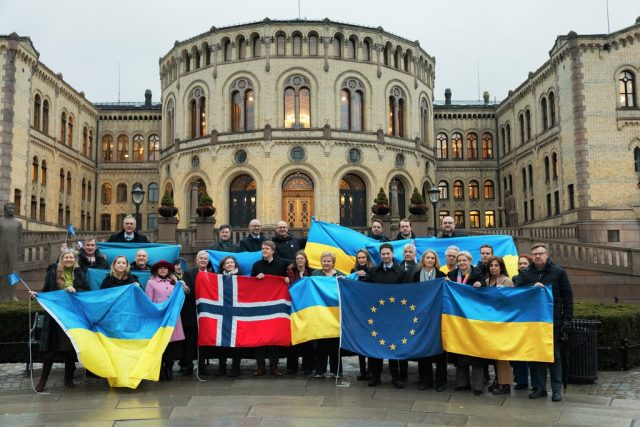
The agreement comes less than two weeks after Norway already had boosted its support for the war-torn country after a full scale invasion by Russia three years ago. “We’re increasing support because there’s a need for it,” Støre said at a late afternoon press conference. He called it “a solid contribution to peace and stability in Europe.”
Commentators in Norway widely hailed the increase. Newspaper Dagens Næringsliv (DN), for example, editorialized how Ukraine “is not fighting first and foremost against Russia, but for its own freedom as a nation.” That, along with recognition of national borders, is also important for every other country in Europe that, like Norway, has been invaded itself and strongly defends national sovereignty.
Ukrainian President Volodymyr Zelensky quickly thanked Norway’s prime minister and said the money will be used to both strengthen its own weapons production within Ukraine and security of its energy supplies. That’s important, not least after Russia launched yet another barrage of bombing later in the week. The support is also important, Zelensky said, for strengthening Ukraine’s position “on the way towards negotiating a fair and lasting peace.”
Norway had initially set aside NOK 35 billion for Ukraine in this year’s state budget. Now its lawmakers are adding another NOK 50 billion, for a total of NOK 85 billion (USD 8.5 billion at current exchange rates) in 2025. “That’s a very, very high amount,” said Støre, who leads a country with a total population of just 5.5 million, but it’s necessary given “the dramatic defense battle” Ukraine remains caught in, while under “ongoing Russian attack” at a time when “changes in the USA have weakened its support for Ukraine.”
Støre was referring to how new US President Donald J Trump has threatened to cut off arms deliveries to Ukraine and halted exchange of intelligence information just in the past week. Trump also has harassed and made fun of Ukrainian President Volodymyr Zelensky, called him a “dictator,” claimed that Ukraine started the war with Russia and discussed a potential peact pact with Russian government officials without including Zelensky. That prompted a crisis meeting of European leaders in London last weekend, to which Støre was also invited.
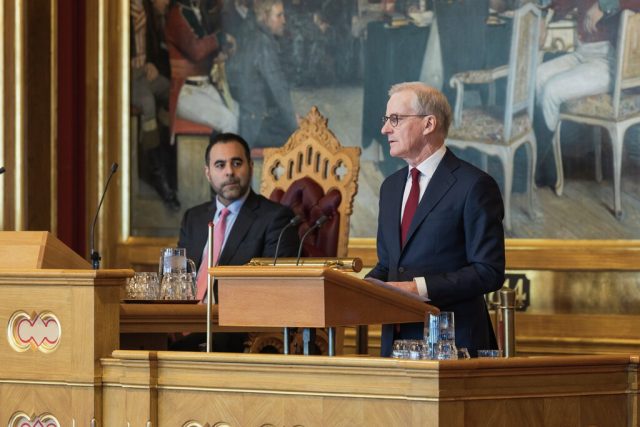
Støre admitted in a special address to Parliament Thursday morning that “the meeting with a new US administration has been hard,” not least since Russia (which also shares a border with Norway) continues to attack Ukraine “with full force” while also mounting a “strong military build-up.” Støre further cited “major changes in American foreign policy and security policy, and in trade policy.”
Støre noted how there “have been many statements made (by Trump and other new US officials) that create uncertainty and reaction. In such a situation, it’s natural to have close dialogue with Parliament on what the recent developments mean for Norway.”
He focused his remarks Thursday on Russia’s war on Ukraine, “the new signals from the USA,” and what his government is doing. The prime minister said he understood how public concern has risen, that “some people are scared, many are uneasy.” He stressed, however, that the situation in Norway’s far northern areas is “stable,” there are few signs that suggest Russia either wants or has the capacity at present to launch any military conflict with NATO (of which Norway is a founding member), and that NATO remains “a powerful defense alliance” in which its members, including Norway, are funding large increases in their defense capacity.
“What I’m hearing from European leaders who speak most often with Trump and the US administration is that the US is standing by its obligations within NATO, including Article 5,” which states that an attack on any NATO member is an attack on NATO itself. There’s been lots of concern lately that Trump wants to pull out of NATO, “but let’s not speculate on that,” Støre said, “and rather just work towards making sure that all allies are living up to their obligations.”
Prime Minister Støre said it’s becoming more clear that the Trump Administration has “an ideological project” in which “priorities are different, their form unconventional, their style often confrontational and more unpredictable.” He stressed that it’s only been six weeks, “and we should be careful not to come to any strong conclusions. We see that words are withdrawn, proposals adjusted. We have also had good conversations on our common interests with this new administration,” because Norway, with its strategic Arctic location and wealth from its offshore oil and gas industry, is “a valuable ally” for the US.
The US has also always been a valuable ally for all the other countries in NATO. That’s why the leaders of NATO countries keep saying that they need to keep working with Trump, and not give him any excuse or reason to break its NATO commitments.
Most other party leaders in Parliament agree that it’s important to maintain good relations with the US no matter who’s in the White House. And all are committed to helping Ukraine and further increasing financial support as needs arise. “It’s important that we stand together on the support,” said Ine Eriksen Søreide of the Conservative Party, who’s both a former defense- and foreign minister. “But I want to stress at the same time that there are such huge changes (in international politics) that there can be a need to increase (aid to Ukraine) even more.”
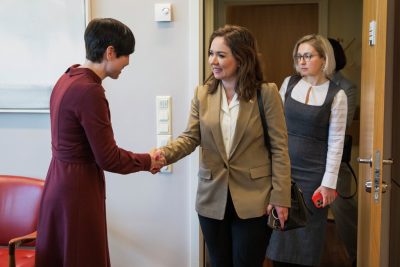
Søreide and all other party leaders are also united on the need to continue building up Norway’s own defense structure and military capability. “It’s important to signal that we must strengthen defense considerably in the revised state budget (which is handled in May),” said Progress Party leader Sylvi Listhaug.
Norway’s new funding for Ukraine, meanwhile, will be directed at “the most important areas on Ukraine’s own list of priorities.” Støre said Norway faces a “great responsibility” to ensure that the money to be pulled out of Norway’s huge sovereign wealth fund known as the Oil Fund will be “controlled and goes where it should.”
Finance Minister Jens Stoltenberg, the former NATO chief who has urged large increases in defense spending and aid to Ukraine, stressed that the NOK 85 billion now allotted for this year still complies with spending limits placed on the Oil Fund, which limit annual withdrawals to 3 percent of the value of the fund. Economists and many others have claimed the rule doesn’t apply to aid to Ukraine, and that Norway could and should be providing Ukraine with far more funding than it has.
Stoltenberg insisted that it’s important to retain a “defensible economic framework.” He said the government “has no plans” at present to withdraw more than the 3 percent allowed this year, but noted that “we can occasionally exceed” the limit as long as less is withdrawn “in calmer times.”
NewsinEnglish.no/Nina Berglund
