

A huge increase in early voting may bode well for overall voter turnout in Norway’s upcoming Parliamentary election. Many Norwegians find the early voting option practical and simple, while others fear the traditional formality of Election Day may fade away.
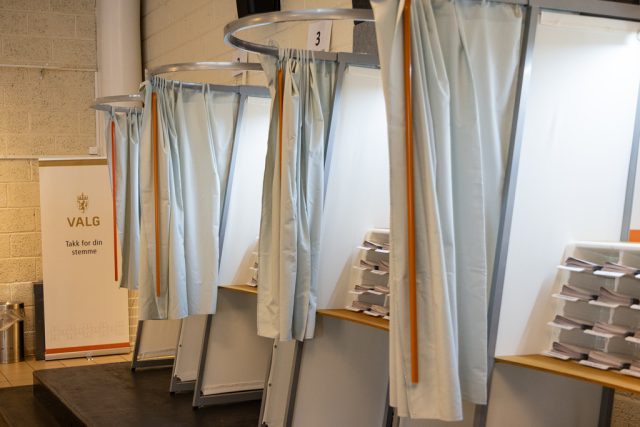
Never before have so many taken advantage of early voting, or voted so far ahead of Election Day, which falls on Monday September 8 this year. It’s already set a record, up 43 percent of the last Parliamentary election in 2021. As of Saturday afternoon, a total of 455,308 Norwegians had already cast their ballots at one of the many early voting booths set up in towns and cities all over the country.
“I had already made up my mind who I was going to vote for,” one woman told state broadcaster NRK after emerging from an early voting booth in Oslo’s Sagene district over the weekend. “This was just a convenient time to go and do it.”
Joakim Kolle, interviewed outside another booth in downtown Bergen, fully agreed. He was part of a steady stream of voters who cast their ballots in the middle of other errands on Saturday. “This is a bit simpler than voting on Election Day,” he told NRK. “You can do it when you have time, and when you’re already in town.”
Gard Thomassen back in Oslo thinks it’s simply practical. “I think democracy functions best when folks are allowed to have control over when they come to vote,” he said. Thomassen thought it was perhaps especially meaningful and a formal occasion when he voted for the first time on Election Day, “but now it’s a bit more routine.” He referred to his early voting, though, as a means of “carrying out perhaps not my civic responsibility, but my citizen’s privilege.”
Early voting accounted for fully 57.9 percent of all voting in the last national election, and may be higher this year. Anders Skaalgaard of the state elections directoratet said he and his colleagues expect a good turnout regardless. It’s been relatively stable at around 76 percent since 2000, much higher than in many other countries, not least the US, where voters have long had to register to vote and now also face looming and controversial restrictions on voting proposed by the Trump administration.
Some reseachers worry that the early voting may have some disadvantages. Jo Saglie of the Institute for Social Research in Oslo told NRK that “we lose some of the ritual around Election Day,” on which both politicians and journalists traditionally even dress up, with suits and ties standard for the men.
Saglie notes how families often all went to vote together on what’s considered a formal occasion. Now they can vote early, in between other daily tasks, and often alone. “Those who are least interested in politics, but perhaps viewed Election Day as a big occasion, may now stay at home,” agreed elections researcher Johannes Bergh, but they both also still expect another strong voter turnout overall.
NewsinEnglish.no/Nina Berglund
