

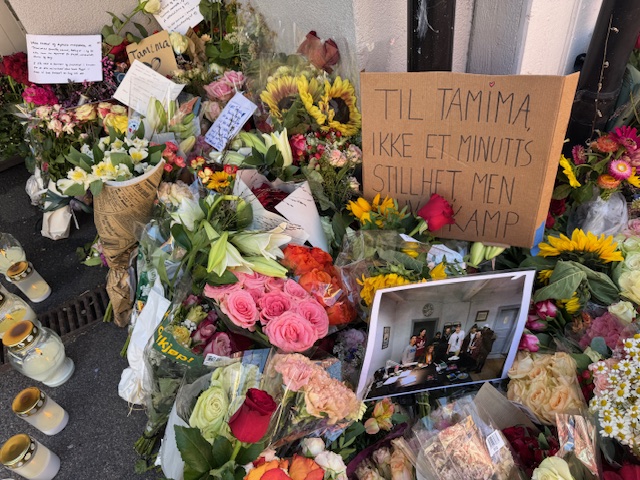
The smiling face of Tamima Nibras Juhar will long be remembered in Oslo, after she was repeatedly stabbed to death last summer by a young white man. He has admitted the murder was racially motivated, that he admired right-wing terrorists and viewed Juhar as “an easy victim.”

The trial of the 18-year-old murder defendant began last week in the Oslo County Court. He is not contesting the charges against him, and even testified that he looked up to right-wing extremists like Adolph Hitler, rulers like Vladimir Putin and racially motivated terrorists.
“I began to think that ‘now I should also do something,'” he said in court during a trial that’s receiving widespread media coverage in Norway. He’s also been publicly identified, unusual since the Norwegian press corps rarely identifies defendants until they’re convicted. In this case, as in others involving racism or terrorism, the admitted murderer has been identified as Djordje Wilms, born in Germany in 2007 to parents from the former Yugoslavia. He moved with his mother to Norway in 2013.
Juvenile authorities were involved with Wilms’ family both in Germany and in Norway, and he was ultimately placed with foster parents in the scenic mountain town of Hedalen in Valdres in 2017. Photos have shown him smiling while grouse-hunting in the mountains, and his foster father testified last week that the young Wilms had “lots of energy” but became “fascinated by violence,” even that which occurred during ice hockey matches. “He would laugh” at violence, according to his foster father, instead of wince.
His now former foster father testified that from the 9th grade, Wilms had less contact with friends and spent more time in his room at home. Newspaper Aftenposten reported from the courtroom that Wilms “began to talk about Hitler and Putin, men who had power over others,” according to his foster father. “When we tried to tell him it wasn’t usual to look up to Hitler or Putin, he said he hated us. He said he wanted to become a dictator who would have power over others.”
Tensions rose in the home and his former foster father testified that “he is a racist and didn’t hide it. He also had a negative view of women, believing women and girls aren’t worth as much as guys.” By 2023 his foster parents needed help caring for Wilms, but didn’t think local authorities understood “how bad it was.” After Wilms threatened his foster mother in February 2024, police were called and Wilms was eventually placed in a privately-operated home in Oslo that was under the auspices of Norwegian juvenile authorities.
That’s where he attacked Tamima Nibras Juhar, age 34, while she was working alone on the night shift. He admitted in court that he decided to kill her “because she was Muslim,” and that he planned it for midnight on Sunday August 24, “because that’s when it was quiet.” While pleading guilty to most of the charges against him, he disputed those that he stabbed and cut her with a knife at least 69 times. He claims it was less than that, “20 to 30,” and that the murder was over after a few minutes.
Wilms confirmed in court that he’d spent most of his time in his room as a young teenager, wasn’t interested in school and watched many videos from Viking times, the German kaiser period and Nazi-Germany. He admitted to threatening his foster mother, grabbing an axe to frighten her and breaking items in the home. He also testified that after killing Juhar, he had intended to post video of the murder on social media, return to his foster parents’ home, take their hunting rifles and then attack a mosque in Hønefoss, another small town between Hedalen and Oslo.
All that, he admitted, was poorly planned and he ended up walking away from the juvenile home after the murder and later riding around Oslo in a taxi. He was arrested only after he couldn’t pay for the taxi. State broadcaster NRK published a retouched police photo of Wilms allegedly smiling while being arrested on Karl Johans Gate in the heart of Oslo, but his face isn’t identifiable because he didn’t want photos of himself published in connection with his trial.
Police had identified him immediately as the suspect in Juhar’s murder just hours earlier, and quickly found the knife he’d used in one of his pockets. “He smiled the whole time and seemed really pleased by what he’d done,” testified the arresting police officer.
The body of Tamima Nibras Juhar had been found in a pool of blood by another resident of the juvenile home and neighbours, one of whom had come home to find an empty car blocking the entrance to their garage. Attempts to find the owner of the car led them to the juvenile home and the shocking discovery of Juhar’s body. Police and ambulance personnel arrived quickly at the scene, but Juhar could not be revived.
Members of her family and close friends have been attending the trial, and remembering her as cheerful, positive and hard-working young woman. They’ve followed the testimony out of respect for her and the need to counter racism in all its forms. “It’s important to not let this case die, and to work even harder to battle hate in society,” Amina Bile, one of Juhar’s friends, told newspaper Aftenposten. “Tamima would have fought such attitudes, now it’s our job.”
The trial runs through this week and can result in a verdict known as forvaring, under which the defendant can be sentenced to a long prison term and only released when a judge determines that Wilms, in this case, no longer remains a threat to society.
NewsinEnglish.no/Nina Berglund
