

Norway was the last stop on an unusual Nordic tour for China’s foreign minister Wang Yi over the past five days. After visiting Denmark, Sweden and Finland, Wang landed in Oslo on Monday for meetings and dinner with Norwegian leaders, and Russia’s war on Ukraine was on the agenda.
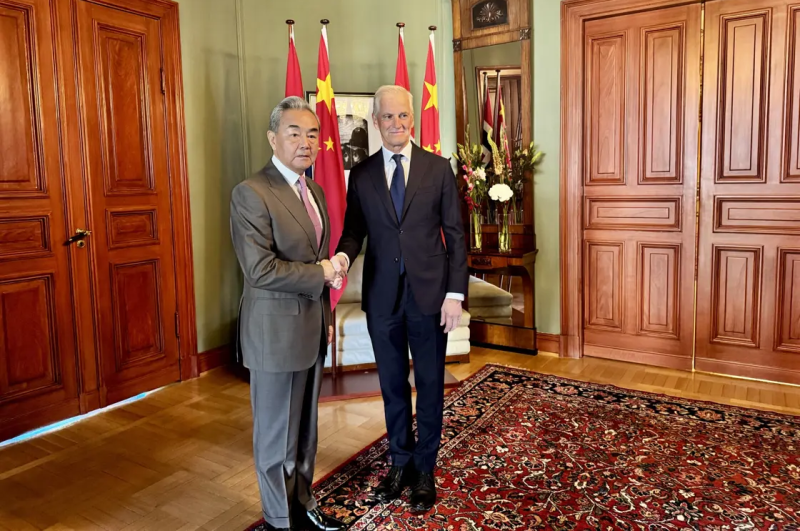
“In these times of global instability,” Norwegian Prime Minister Jonas Gahr Støre stated afterwards, “it is vital that we maintain a constructive dialogue with China. Norway is seeking to further develop cooperation in areas where this is in our interests.”
Among those “areas” was Russia’s war on Ukraine, now in its fifth year and with Ukraine on the offensive with waves of drone attacks on Russian targets. Russia, however, keeps responding with attacks on residential buildings and critical infrastructure, with Europe and the Nordics waking up almost daily to more news of civilians being killed during the night. China, meanwhile, has helped finance the war launched by Russian President Vladimir Putin, by continuing to purchase Russian oil and gas and ignoring most of the rest of the world’s economic sanctions on Russia.
The Norwegian prime minister said it was “important to discuss issues where Norway and China have differing views. For example, I raised the issue of China’s support for Russia’s war against Ukraine and underlined how important it is for China to contribute to efforts to achieve a ceasefire, and advance negotiations towards securing a just and lasting peace in Ukraine.”
Neither Støre nor his foreign minister, Espen Barth Eide, went into detail about Wang’s response, but Støre claimed during a press briefing afterwards that “we agree that the war must end soon.” He said Norway urged China to work to end the war, not continue to finance it even indirectly.
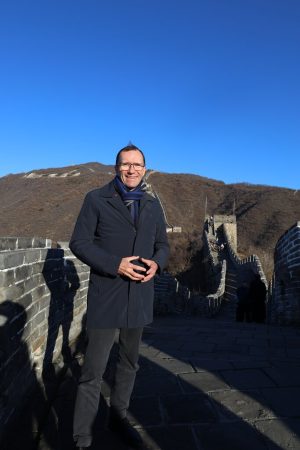
Eide also claimed that he and Støre “strongly urged” Chinese leaders to in turn urge Russia “to come to the negotiating table without conditions.” Eide said other Nordic leaders had done the same, in what appears to be some coordinated planning before Wang began his Nordic tour.
The fact that Wang, widely viewed as one of the most powerful men in China after its supreme leader Xi Jinping, spent five days visiting Nordic countries illustrates how important they seem to have become in China’s eyes. They’re a prosperous and well-functioning group within NATO, and located in one of the most strategically important regions of the world in terms of both defense and natural resources. All the countries Wang visited sent the same message to the man who has Xi’s ear: China must stop supporting Russia’s warfare.
It was likely no coincidence that Wang’s visit came on the eve of the NATO summit in Ankara this week. Nordic countries, Canada and most of the EU have also taken a firm stand against US President Donald J Trump’s attempts to take over Greenland. Relations between China and the US have been tense because of Trump’s tariffs and his aggression, with China keen to enforce a rules-based world order not least regarding trade issues. Norway, other Nordic countries and the EU also want that, even though the EU sees a need to counter new tariffs with some of their own.
Other areas under discussion in Oslo on Monday involved both trade and climate issues including renewable energy projects and emissions control, where China is making more progress than most other countries. China still stands for more than 30 percent of the world’s harmful emissions, but they’re on the decline thanks to Chinese climate technology and huge wind- and solar energy projects.
Wang’s visit also coincided with a report in the Kirkenes-based Barents Observer that four Chinese icebreaking research vessels had sailed into the Arctic Ocean (external link) on July 3. Their mission was to monitor climate change and its impact, conduct “comprehensive surveys and monitoring” in key Arctic areas of sea ice, hydrology, biology, ecology and atmospheric environment, according to the Polar Research Institute of China. One of the vessels was originally built as an Arctic cargo vessel at the Kherson shipyard in Ukraine, the Barents Observer noted.
China’s keen interest and various activities in the Arctic have raised concerns, both for the further climate harm that could be caused by new polar trade routes and for national security. Both China and Russia have long been viewed as among the biggest threats to cyber security and espionage. It’s unclear whether security issues came up at the meeting, too, but Støre commented on them.
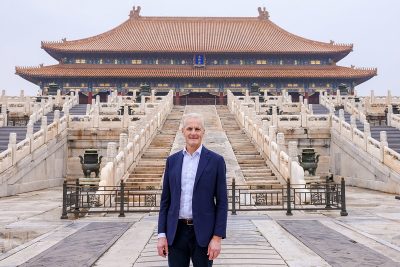
“While cooperation with China is to Norway’s benefit in a number of areas,” Støre stated after the meeting, “China also poses a growing security threat to Norway. For reasons of national security we are therefore exercising greater vigilance in our dealings with China and we are working with allies to reduce vulnerabilities, including dependence on Chinese players.”
Støre said he also raised another thorny issue with Wang: China’s human rights violations. As demonstrators from the Norwegian Uighur Committee, the Norwegian Tibet Committee and Falun Gong protested outside the meeting at the government’s guesthouse behind the Royal Palace in Oslo, Støre said developments in Xinjiang, Tibet and Hong Kong and “the human rights situation” in China “is cause for concern.” Støre added that Norway “urges the Chinese authorities to comply with their international obligations.”
Norwegian Broadcasting (NRK) reported how Wang and everyone else could hear the demonstrators outside shouting that China is a dictatorship. “We of course took up these issues,” Eide told reporters. “I did that today and many times before.” Eide claimed the issues were taken up “within the framework of respectful dialogue. We understand that China is coming from another place with another history.”
Norway and China were in a diplomatic freeze for six years after the Norwegian Nobel Committee awarded the Nobel Peace Prize to Chinese human rights activist Liu Xiaobo in 2010. The Chinese were furious and cut all relations with Norway immediately, even trying to disturb the Peace Prize ceremony and refusing to let the jailed Liu attend. When Liu later died of cancer while still in custody, Chinese authorities wouldn’t allow the committee leader to visit Liu. It wasn’t until 2016 that diplomatic relations between Norway and China were normalized, but they remained tense for years.
Norwegian leaders and even King Harald V have since visited China, Støre was there in 2024 and Eide visited last fall. There’s still no free trade agreement between the two countries, though, and Norway remains firm that China should recognize international obligations tied to human rights.
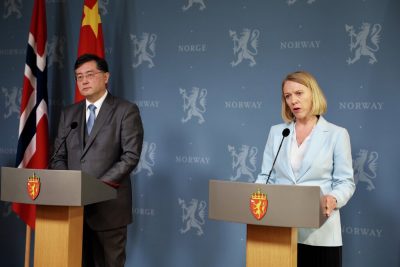
The last time a Chinese foreign minister visited Norway, meanwhile, was in May 2023, when Wang’s predecessor Qin Gang traveled to Oslo and met reporters with Eide’s predecessor Anniken Huitfeldt, who’s now Norway’s ambassador to the US. Just a few months after Qin’s visit, though, he abruptly disappeared and was succeeded by Wang. Qin’s goal had been to urge Norway and Europe against following the US’ hard line against China at the time, even before Donald Trump returned as president. His fate remains unclear, with no explanation from the Chinese.
Some media commentators in Norway were musing about whether Wang may encounter the same fate, but most deemed that unlikely. The official Chinese explanation for Wang’s visit was to examine “bilateral questions and international issues where Norway and China have common interests.” Others called Wang’s visit a “charm offensive” aimed at all the Nordic countries, just as EU officials sharpen their tone and have been accused of protectionism when faced by steadily stronger competition from China.
Hans Jørgen Gåsemyr, a senior researcher at the Norwegian foreign policy institute NUPI, viewed Wang’s visit as China’s recognition of the Nordic countries’ importance. “I see the visit as a welcome sign of how much the Nordic countries mean to China,” Gåsemyr told newspaper Klassekampen. He also thinks the visit shows that the Nordic countries’ recent efforts to work together in a turbulent are bearing fruit.
“China wants to talk on a bilateral level, but they have also marked that they will talk about international and regional interests, and I think that’s very exciting given the Nordic countries’ placement in the world,” Gåsemyr said. “It’s up to the Nordic countries to get together for maximum influence.”
NewsinEnglish.no/Nina Berglund
