

NEWS ANALYSIS: The dramatic end over the weekend to the UN’s annual climate summit left oil-producing Norway embarrassed, disappointed and on the defensive once again. The lack of an international agreement to reverse climate change and compensate those suffering from it left Norway among “oil nations” accused of staging a coup to “greenwash” fossil fuels.
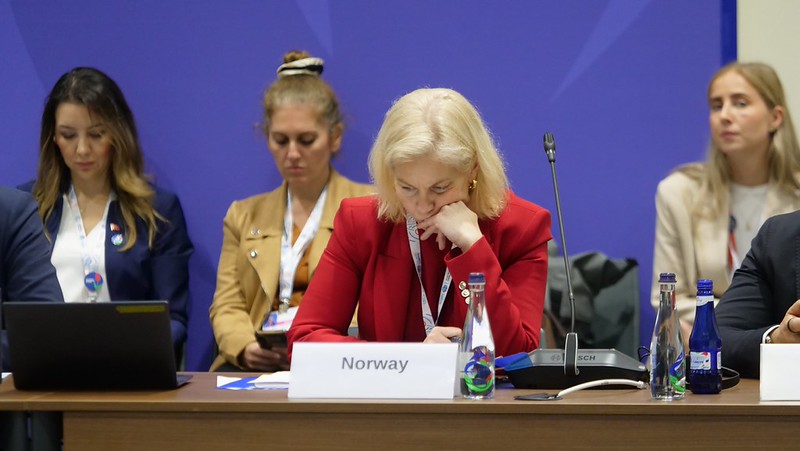
Norway’s delegation was among the oil- and gas producing countries that contributed to the lack of an agreement on how to cut carbon emissions. While Norway called for “higher ambitions and a faster tempo” for emission cuts, the Norwegian government once again refuses to rein in its own oil exploration and production that’s keeps controversially extending into the Arctic.
Norway, whether led by Labour- or Conservative governments, continues to believe that its offshore oil and gas industry is more environmentally friendly than those in other countries. Norwegian governments over the years also continue to defend the fossil-fuel industry’s expansion into the Arctic. The current Labour government prefers to stress production of more renewable energy both at home and abroad, and promotes more electrification to reduce the use of fossil fuels.
“We must make the world less dependent on fossil energy,” claimed Sigrun Aasland, Norway’s new Labour government’s minister in charge of climate and environmental issues, right after the climate summit ended. “That demands expansion of renewable energy and electrification.” She also complained of a lack of “more clear agreement that a global energy restructuring is needed.”

At the same time, however, Norway remains far from meeting its own climate goals at home. Carbon emissions are the lowest since 1990, but state statistics bureau SSB (Statistics Norway) recently reported how the country had set a cut of at least 55 percent by 2030. The actual reduction so far amounts to 14.1 percent even though Norway has among the world’s highest use of electric vehicles.
What’s worse, according to the Greens Party and climate activists, is that Norway takes no responsibility for emissions created by the use of its oil and gas abroad. Once Norwegian fossil fuel is exported, its emissions belong to the country where they’re emitted. Norway has helped pay other countries to cut their emissions, for example by trying to save rain forests in the Amazon and elsewhere, but keeps expanding highly profitable production and export of fossil fuels.
State-owned oil company Equinor recently reported more record profits, and is keen on expanding into Norway’s offshore Arctic territory. Some analysts even claim that “there’s a real ‘drill, baby, drill'” sentiment in both the Norwegian oil and gas industry and in the government, which consistently claims Norway’s gas is needed in Europe especially after Russia invaded Ukraine. The vast majority of profits from Norway’s oil and gas industry are placed in the country’s huge sovereign wealth fund known as the Oil Fund, to secure pensions for future generations.
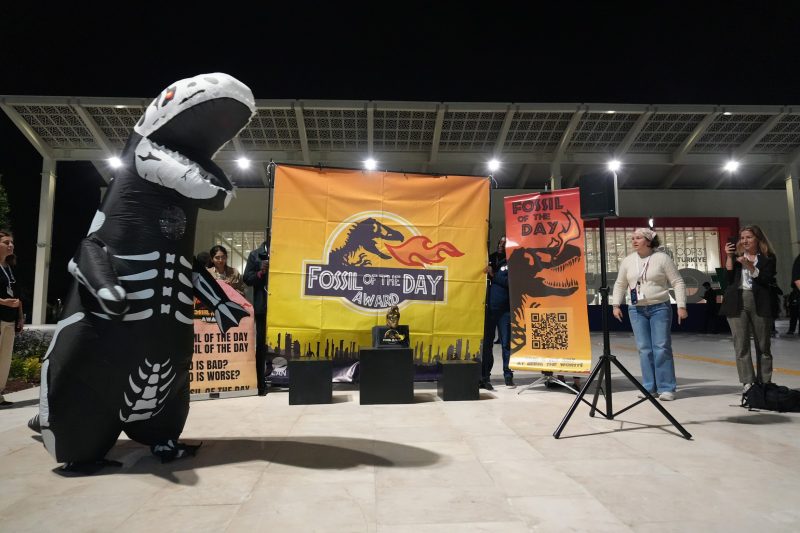
All this is what resulted in Norway’s dubious honour of winning Climate Action Network (CAN)’s “Fossil of Day” award during the UN summit. “Norway has perfected a new model of climate leadership: electric cars at home, oil and gas for everyone else,” claimed CAN in a sarcastic announcement sent around the world. “Export the fossil fuels, pocket the profits and offer developing countries a workshop on (a) Just Transition.”
CAN mocked how Norway “has been showcasing its renewable energy, its climate finance and its enthusiasm for false solutions like carbon capture and storage” while nearly all the oil and gas Norway produces (and earns lots of money on) is exported. “Apparently emissions stop being Norway’s problem once they clear customs,” CAN wrote. “They become the problem of families in Nepal, farmers in the Sahel and islanders in the Pacific instead.”
CAN also stressed that Norway “refuses to develop a roadmap to phase out its fossil fuel production and exports. The only maps Norway seems interested in drawing are those showing where to find more oil and gas.” CAN rejects Norway’s claims that its Arctic exploration is important for European energy security. “Awkwardly, its biggest customer, the EU, reaffirmed last month that Arctic fossil fuels must stay in the ground,” CAN wrote.
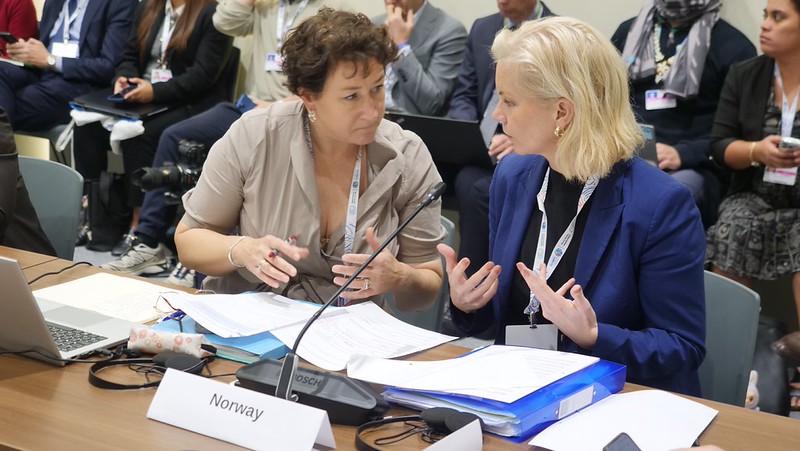
The Irish leader of the EU’s delegation at the UN summit refused to accept “greenwashing” of fossil fuel, and accused oil nations of blocking any agreement. Norway’s own Greens Party thinks CAN’s “Fossil of the Day” award reflects hypocrisy with the Norwegian government.
“It’s super-embarrassing for Norway to be hung out as among the worst ‘fossils’ because we say one thing and do something else,” Frøya Skjold Sjursæther, a Member of Parliament for the Greens, told state broadcaster NRK. “Norway asks others to restructure (away from oil and gas), but keeps on searching for more oil itself. That’s incredibly hypocritical.”
Climate Minister Aasland said she was “disappointed” by the outcome of the UN climate conference, which had attracted around 14,000 delegates from around 200 countries. She claimed that she’d hoped for a better result, but admitted Norway wouldn’t go along with the agreement that was proposed.
She told NRK that the Norwegian delegation feared the proposed agreement “would take away some of the things we’d agreed on earlier, therefore neither Norway nor many other countries didn’t want to be part of it.” The two-week-long conference was supposed, she claimed, to be all about “implementation and follow-ups” of earlier agreements.
Aasland stressed, meanwhile, that “the world still stands together on the goals of the (UN’s) Paris Agreement, at a time when international cooperation is being challenged.” She noted that when the Paris Agreement was approved, global warming was rising to more than four degrees. “Now it’s around 2.5 degrees,” she said, “so it’s working.”
NewsinEnglish.no/Nina Berglund
