

The Norwegian Labour Party, deeply troubled until just weeks ago, suddenly has the most voter support of all 10 parties represented in Parliament. Labour’s leader, Jonas Gahr Støre, also has a good chance to return as prime minister in the September election after the most stunning turn of events in Norwegian political history.
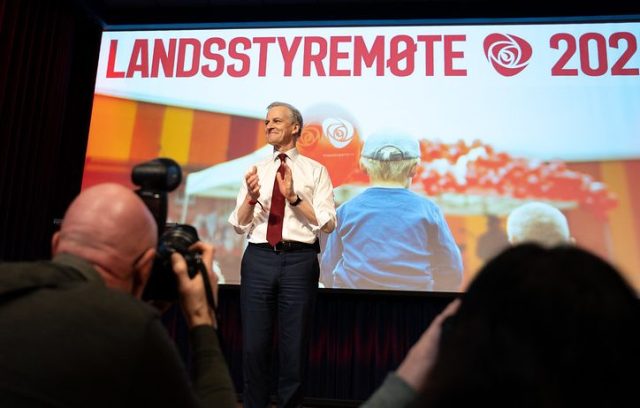
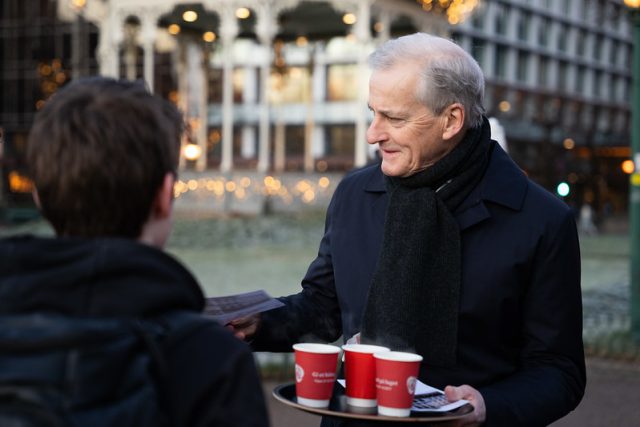
“This is of course a huge source of inspiration,” Støre told reporters as he mingled with potential voters during the morning commuter rush in Bergen earlier this week. He and his party colleagues were there for a long-planned national board meeting that surprisingly turned into an upbeat re-election campaign rally.
Støre was referring to new public opinion polls that showed Labour soaring, from a poll average of 18 percent in recent months to over 30 percent in one poll conducted for newssite Nettavisen. Labour also scored 26.7 percent in another poll for newspapers Aftenposten, VG and Bergens Tidende.
Both polls placed Labour as Norway’s largest party at present, with the right-wing Progress Party second at 23.6 percent in the Aftenposten poll. The Conservatives fell to third place with a lowly 19.1 percent, further raising spirits among the top Labour politicians meeting in Bergen, which is the hometown of Conservatives leader Erna Solberg.
Then came another poll conducted for Norwegian Broadcasting (NRK) showing the same trend, with Labour soaring 8.5 points and also landing on top, ahead of both Progress and the Conservatives. Political analysts were quick to note that Labour won voters away from all the other parties but that the left-leaning ones could still form a majority coalition at present.
It was Støre’s recent and much-hailed decision to part company with the anti-EU Center Party in their long-troubled minority coalition government that started the ball rolling. Commentators called it a bold decision by Støre, who’d earlier been criticized for weak leadership and faced a coup within his own party, to go it alone with the first single-party minority government in 25 years. And then he stunned both party colleagues and rivals by securing his own former party leader and prime minister Jens Stoltenberg as Norway’s new finance minister. Stoltenberg recently ended an unprecedented 10-year-term as an unusually popular security general of NATO, during which he became an international superstar who’ll now work once again for Norway.
Støre appealed to the media and voters to “give us a fair chance” after his new Labour government was royally appointed just last week, and they clearly have. The poll results started rolling in immediately, commentators wrote about “euphoria” within Støre’s party and, not least, nationwide.
“There’s a hallelujah mood in the whole country,” wrote Lars West Johnsen, editor of newspaper Dagsavisen. He quoted an anecdotal conversation with an Oslo taxi driver who claimed Støre “had colour back in his cheeks” and that Stoltenberg would boost morale among Labour members. “This will be good,” he claimed, and many agree according to a string of random interviews on the street by NRK and other media.
Some have gone as far as claiming that Støre and Labour are in the midst of no less than a resurrection, just months after calls were going out within the party to replace Støre as party leader. Instead, Støre responded by getting out of an unhappy government partnership with Center and teaming up instead with his old friend and colleague Stoltenberg. Even former critics called that a brillant move, not least at a time of war in Europe, constant threats from Russia and an unpredictable, ultra-right-wing US president who’s already launching trade wars and even threatening allies.
Norwegians quickly grasped that Støre and Stoltenberg are well-equipped to lead the country during a time of international crises. While the Center Party seemed more concerned about keeping electricity rates low and was willing to challenge the EU instead of cooperating with it, Støre and his renewed Labour Party were more concerned about what’s best for the nation.
“We will move forward, not backwards,” Støre himself claimed, while also clearly delighted that Stoltenberg would join his team even if only until the September election. As finance minister, Stoltenberg’s job is to concentrate on the Norwegian economy, but security issues are involved in that as well. Few are better connected on both than the former NATO chief.
Støre also quickly addressed the electricity- and other energy issues facing Norwegians, proposing a new program that would allow Norwegians to secure relatively affordable rates for a set period even before he sprung the Stoltenberg surprise. The proposal was viewed as both a response to his former government partner has sparked criticism, but it was another sign that Støre and his new government are on a well-received offensive.
That’s bad news for the Conservative Party and its longtime leader and former prime minister Erna Solberg. Not only have the Conservatives fallen dramatically in the new public opinion polls, Støre himself has identified his main rival not as Solberg, but rather Sylvi Listhaug, leader of the more conservative Progress Party.
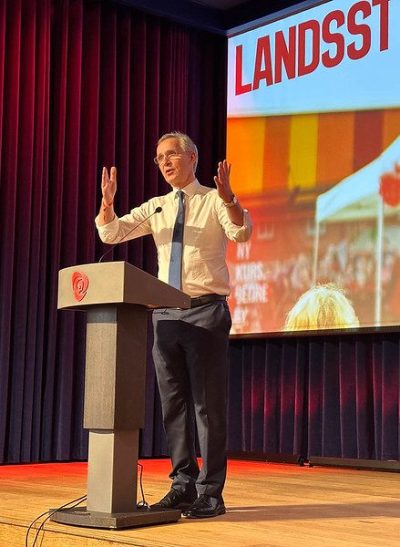
Støre told party fellows at their board meeting that their new minority government (which holds just 26.3 percent of Parliament after the last election in 2021) must be humble and open to negotiating with all parties when they need to reach a majority on various issues. As part of that strategy, however, Labour can now be clear about its own positions without having to compromise with the Center Party.
“We must set up our policies against what the Progress Party stands for,” Støre said. “What are the consequences of commercializing our welfare services, the school and health care programs? What would it mean for workers if rules are removed and more temporary contracts are allowed? It will be our job to show that we have better policies.”
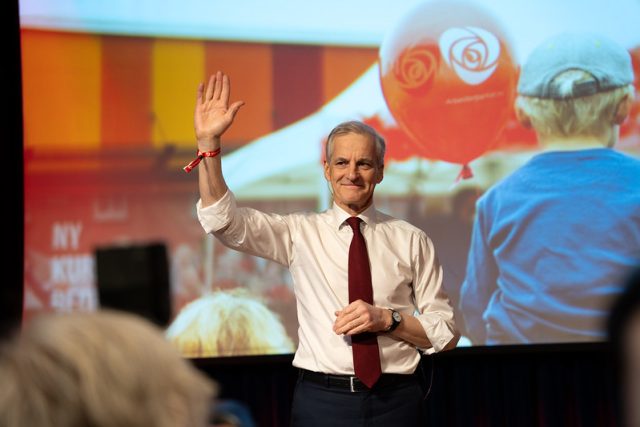
Støre noted that several of the opposition parties already agree on the major increase in defense spending and support for Ukraine. “And that’s Norway at its best,” Støre said, “but in terms of the main direction for our society, we offer two alternatives.”
That can leave the Conservatives caught in the middle between Labour and Progress, even with Listhaug as the main non-socialist candidate for prime minister instead of Solberg. Her Conservatives and Labour actually agree on many other issues, too, like the importance of Norway’s trade agreement with the EU and even the advantages of potential EU membership, an issue that’s gaining more momentum on almost a daily basis. It can be more difficult for Solberg and Støre to identify their differences, as they need to in politics. “The Conservatives are in trouble now,” wrote political editor Kjetil B Alstadheim in Aftenposten on Tuesday.
There’s no question, meanwhile, that the formerly embattled Støre and his Labour Party have received “a new vitamin shot” or “a triple espresso,” as Alstadheim also wrote. Støre also intends to campaign for a pure if minority Labour government after the September election, instead of having to compromise in any new left-center coalition. The biggest question is whether Stoltenberg will continue to be part of it after the next seven months as finance minister.
“I’m taking one thing at a time now,” Stoltenberg told newspaper Bergens Tidende (BT) this week. “In politics we have to have ‘forever’ as a perspective, but also be prepared to have to quit on a day’s notice. We’ll see what the voters say, and what the prime minister says.” Would he like to stay on? “I’m thriving as finance minister,” Stoltenberg said before flying off to Munich with Labour’s large delegation of party colleagues including Norway’s foreign minister, defense minister and new minister in charge of foreign aid.
NewsinEnglish.no/Nina Berglund
