

NEWS ANALYSIS: Oil and gas prices shot up, as did the share prices of many Norwegian companies, after Israel and the US launched their attack on Iran last weekend. Once again, Norway as an oil- and gas-producing nation finds itself benefiting from the sort of military action it otherwise condemns, and Prime Minister Jonas Gahr Støre is calling for the attacks to end.

Støre and his foreign minister, Espen Barth Eide, were quick to criticize the initial attacks on Iran, also the Iranian retaliation not just on Israeli targets but also several other countries in the Middle East. Støre repeated his criticism on national radio Tuesday morning.
“We strongly distance ourselves from the attacks, and that civilians are being hit hard,” Støre said on Norwegian Broadcasting (NRK)’s morning talkshow Politisk kvarter. He also expressed concern over how “the economy, people and civilians are pulled into this.”
Støre believes the US and Israeli attacks on Iran violate the international rule of law. He also criticized Iran’s counter-attacks on several neighbouring countries including the United Arab Emirates, where more than 2,000 Norwegians are among those stranded after airspace closed along with local airports. Some flights were resuming on Thursday, but global aviation has been severely disrupted.
The criticism of Israel’s aggression along with that of the US, long viewed as Norway’s most important ally, sparked strong rebukes from the Israeli Embassy in Oslo. Israel has no ambassador in Norway, but its Chargé d’Affaires Eytan Halon claimed the Norwegians’ criticism was “disappointing” and not rooted in reality. He wondered “which side of history” Norway wants to stand on, and further claimed Norway’s criticism of the attacks launched by the US and Israel differed from other European countries’ views.
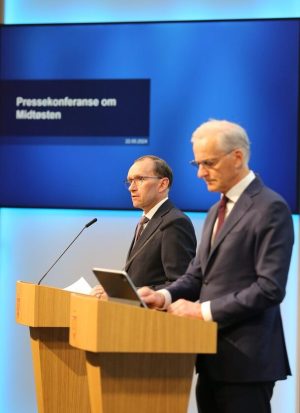
Støre and Eide are far from alone in their views, however, and Eide later said he “completely disagreed” with Halon’s assessment. “It’s extremely important for us to try to maintain a world order based on the main principle that no one is allowed to go to war against another country,” Eide told NRK. “You only are allowed to defend yourselves.”
Eide remained firm in his belief that there is no allowance in the international rule of law “to go to war for regime change, or to attack as a means of preventing a threat (of attack).”
Støre, meanwhile, doesn’t think Norway will get directly involved in the war. “We have no bases in the region,” he said. “We have some defense forces who’ve been contributing to stabilizing Iraq, but this is not a war Norway shall become part of.”
Norway is already affected, however, in several ways, not just because of its large oil and gas industry. Companies like Norsk Hydro, with aluminum operations in Bahrain, Qatar and the Emirates, and not least Norway’s shipping industry risked getting caught in the crossfire. Several Norwegian-owned or managed oil tankers were caught in the Persian Gulf after Iran closed the Straits of Hormuz, while others were exposed to missiles in the Gulf of Oman. Most were ordered to remain still at anchorage, in the belief that would be the safest for both crews and cargo.
The foreign ministry, meanwhile, sent a team to the Norwegian Embassy in Abu Dhabi to help Norwegians in the area with everything from passport issues, ID papers or emergency funds to cover unexpected costs of being stranded when airports closed. Some airlines resumed limited flights on Thursday, but thousands remain stuck in the region, especially in Dubai. It’s long been both a popular holiday destination and a business center for Norwegian companies.
Meanwhile, back in Norway, salmon- and other fresh fish exporters were facing “an acute crisis” in getting their perishable seafood to markets in Asia. Airspace over Russia has been closed since Russia invaded Ukraine four years ago, forcing most flights to go through the Middle East. With its airports mostly closed now, transport channels are severely disrupted.
While share prices jumped in Norwegian companies tied to oil, gas and shipping because of higher prices and rates, airline stock took a dive. Shares in the recently recovered Norwegian Air fell around 11 percent earlier this week, mostly because of the costs of aircraft groundings and higher fuel prices. Norwegians were also bracing for higher prices for fuel, food and any flying they dare to do themselves.
Most important of all, meanwhile, is the nagging feeling that the world order as they’ve known it is eroding with Donald Trump aggressively asserting himself in Washington and the world. As Eide himself said in an address to the Norwegian Parliament this week, the United Nations pact has been at the heart of international law, NATO has aimed to protect both North America and Europe, the Council of Europe has presided over enforcement of human rights, there’s been economic integration in Europe and free trade has led to widespread economic development.
Now Trump is threatening all of that, and as Eide put it, “the liberal world order is under great pressure.” At the very least, Eide said, “we’re seeing a powerful American re-orientation. We see a more unpredictable USA.” During the past year, “we’ve seen more examples of how also the USA challenges both the prohibition of abuse of power under the rule of law as well as other countries’ sovereignty.” He stressed that “we’re living in a more dangerous and unpredictable world.”
Like many other European countries, Norway is now “being dragged into” a war in the Middle East “that they weren’t part of planning,” wrote commentator Simen Ekern in newspaper Dagens Næringsliv (DN). Ekern noted how European leaders from the UK and Germany to Norway, Italy and Spain (which has been among the most critical) were left out of the attack plans laid by the US and Israel, even though the consequences for them can be greater than for most Americans.
NewsinEnglish.no/Nina Berglund
