

NEWS ANALYSIS: Norwegians could finally focus on domestic issues when their national election campaign kicked off in earnest this week, but it didn’t last long. Taxes, schools, health- and elder care were suddenly overshadowed by international drama once again, putting the revived and incumbent Labour Party back on the defensive.

Labour is led by career diplomat Jonas Gahr Støre, whose international expertise and connections have served him (and arguably Norway) well during Russia’s war on Ukraine, the Israelis’ war on the Palestinians and the return of Donald Trump. Last week, though, brought new uproar over the Norwegian Oil Fund’s investments in Israel, and both Støre and his popular finance minister Jens Stoltenberg had to settle it quickly.
They now hope the worst is behind them and that even they can pay more attention to political issues at home. Støre won new support for his government last winter when he recruited former NATO chief Jens Stoltenberg to take over as finance minister, after the Center Party withdrew from his sagging coalition early this year.
Since then, Støre’s Labour Party (Ap) has gone it alone and soared in public opinion polls, while his traditional main opponent, Erna Solberg’s Conservatives (H), has fallen hard. She’s also being directly challenged by her own former government partner, Sylvi Listhaug of the even more conservative Progress Party (Frp), changing the dynamics of Norwegian politics. Suddenly Støre has faced Listhaug as his major opponent for the prime minister’s post, not Solberg.

The most recent polls still show Labour as Norway’s biggest party at present, with 28 percent of the vote. Støre also is more popular among voters as a prime minister candidate than Solberg and Listhaug combined. Newspaper Aftenposten reported Wednesday on a new survey also conducted for the paper by research firm Respons. In it, Støre won support as prime minister candidate from 45 percent of those questioned. Solberg won 24 percent, with only 19 percent wanting Listhaug as prime minister. The remaining 12 percent either didn’t want any of them, or were uncertain.
Meanwhile, Støre and his Labour Party would need to negotiate support from other parties if election results prompt Støre to form a new coalition government. The current polls indicate he’d still have a minority government even with support from parties on the left side of Norwegian politics, since Rødt has just 5.8 percent and the Socialist Left (SV) 7.1 percent. Not even teaming up with the Center Party (Sp) again would give them a majority, since Center only held 7 percent in the same recent poll.
That’s all left Støre indicating that he’s keen to carry on alone with a pure Labour government, seeking support from various parties on various issues when needed. He told news bureau NTB this week that it was “demanding” to govern in a multi-party coalition government without a majority in Parliament. “Labour has shown over the past half-year that we govern well and securely (alone),” Støre said. “We can continue with that and find good solutions in Parliament.”
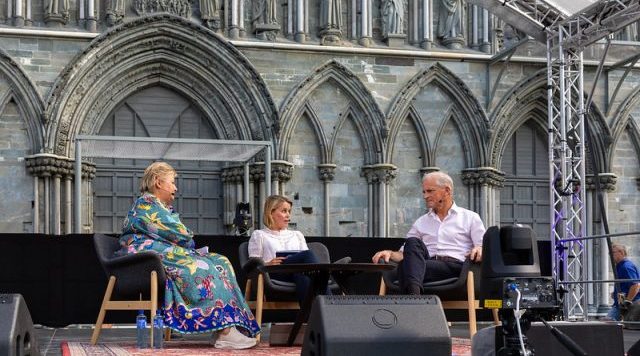
Progress, meanwhile, has also climbed in the polls (up to 23.3 percent in late June and even higher by mid-summer) but settled back to 20.7 percent in the latest one. That’s still much higher than the Conservatives’ 15.2 percent, which Aftenposten claimed was its poorest showing just ahead of an election in 16 years.
“We are not satisfied with this,” Solberg told Aftenposten just before the first major party leader debate in Arendal on Monday. “If we’re going to get a new non-socialist government, we must make sure that Høyre (the Conservatives) grows.” She doesn’t like being reminded how her husband Sindre caused lots of trouble for her when his stock trading (much of it carried out while they lived in the prime minister’s residence) raised questions of conflicts of interest and hurt her credibility. Even though calls went out for her resignation as leader of the Conservatives, she didn’t, and has tried to carry on since on a platform of lower taxes, law and order, a better education system and better “balance” between the public- and private sectors.
Solberg has earlier claimed her party needs to climb over 20 percent, even if Progress does the same, and they’d need both the Christian Democrats (KfF) and the non-socialist Liberals (Venstre) to stay above 4 percent, to win more seats in Parliament. Right now all four parties on the conservative side of Norwegian politics lack a majority, just like the fragmented parties on the left. The Greens, which waiver between right and left, logged just 2.8 percent in the most recent poll, reflecting how climate issues lost their steam when wars broke out and both Norway’s oil and gas have been needed.
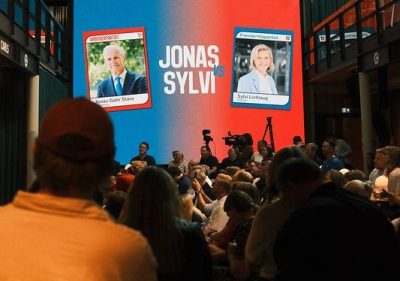
Another challenge for Solberg is how Progress, Norway’s most right-wing party, goes its own way under Listhaug and hasn’t made more of an effort to unify the non-socialist side. Listhaug has even seemed to sabotage parts fo Solberg’s agenda, introducing Progress’ own programs for health care, for example, that run counter to the Conservatives’. Progress otherwise is calling for better health- and elder care, tax cuts that “would let people keep more of their own money” and more police. Listhaug also is calling for Norway’s maximum prison sentence to be raised to 50 years, up from 21 now although the most serious offenders can be held for life.
Listhaug won’t say, though, whether she wants to be prime minister, instead of Solberg, in a new non-socialist coalition government. She has, however, repeatedly claimed that the largest party in any coalition government should have the prime minister’s post, leading commentators to think she’s most interested in using that as a negotiating tactic if Progress ends up bigger than the Conservatives. Listhaug said at a recent meeting with foreign correspondents in Oslo that she favours politics over position, and the only ministerial post she’d insist upon is education. Solberg, meanwhile, has made it clear she wants to return to the prime minister’s post, which she held from 2013 to 2021.
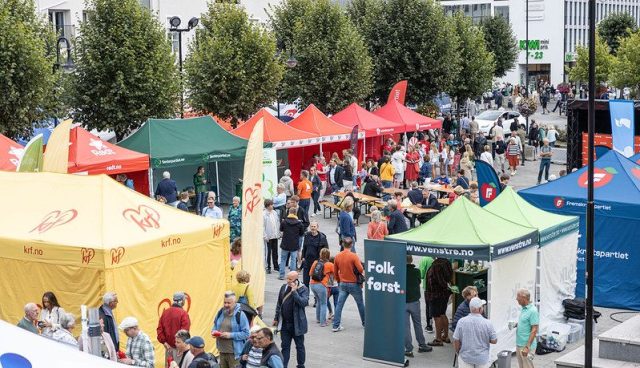
Most all of Norway’s parties have complained that their domestic agendas have constantly been overshadowed during the past four years by international events. Political commentator Frithjof Jacobsen noted as early as March that hardly any top politicians were talking about Norway or Norwegian issues, even though the September 8 election was only six months away. Everyone was much more preoccupied with Russian aggression, the war in Gaza, aid to Ukraine, Trump’s tariffs and other foreign policy issues.
“In normal times, Norwegian parties would be arguing about taxes, roads, screen time and local governments’ responsibility,” Jacobsen wrote at the time in DN. “It’s ominously quiet in the political debate, as if our politicians have been as shocked as the rest of us.” Aftenposten’s Kjetil B Alstadheim followed up in June by writing that the Conservatives “dreamed about a more peaceful world,” because then there would be more time to talk about taxes, schools, health and the police.
The domestic debate has picked up, not least with Monday night’s largest party leader debate in Arendal that was broadcast live nationwide. It wasn’t until the end of the lengthy debate, however, that it really took off and tempers rose over what some called the “scandal” over revelations of the Oil Fund’s investments in Israeli companies that defied the fund’s own ethical standards. Most were quickly sold off, and Støre’s government was working hard on damage control as the week began.
Now, finally, election researchers say the most important issues in Norway’s short, formal election campaign over the next four weeks will revolve around taxes, schools, defense and health. There’s a lot of agreement on defense and preparedness issues, and Parliament has already committed to bring its defense budget up to 5 percent of GNP. All parties in Norway also continue to firmly support Ukraine and its president, Volodomyr Zelensky, and most want to keep channels open in the Middle East while also recognizing and supporting a Palestinian state even though Progress seems to be waffling on that. It wants less government involvement abroad and more at home.
The biggest disagreements among Norwegian politicians are within taxes (the left side wants to maintain current tax levels to reduce social differences, while the Conservatives and Progress want to lower them), job creation, immigration and integration challenges, schools and crime. There’s sure to more debate on all that as the election draws closer.
“If the agenda continues to be dominated by the international situation, it will favour the current government,” election researcher Jonas Stein told newspaper Dagsavisen last week. “If it’s more closely tied to taxes and private economy, it will benefit the conservative side.” Since there’s still so much overall political agreement in Norway, especially regarding defense, no one is expecting major changes even after the election. The campaign climate is also cordial and respectful. Some commentators call that uniquely Norwegian, and a sign of just how stable and lucky Norwegians really are.
NewsinEnglish.no/Nina Berglund
