

Norway’s offshore oil and gas industry has made the country wealthy during the past 50 years, but support for more oil exploration is waning. Nearly all the parties that Labour needs to support its government want to halt or slow down exploration, to ward off more climate change, and so do a solid majority of Labour’s own voters.

Labour Party officials including Prime Minister Jonas Gahr Støre have long wanted to “develop, not phase out” Norway’s oil and gas industry. So do the two largest parties in opposition, the conservative Progress Party and the Conservatives, meaning all three can still form an unlikely pro-oil majority in Parliament.
Labour, however, will continue to seek support from more like-minded parties and thus wants to negotiate agreements this fall with the Reds, the Socialist Left and Greens parties, along with Labour’s former government coalition partner, the Center Party. Center has a history of being pro-oil, but performed so poorly in the recent national election that Labour and Center together only have 33.8 percent of the vote, not enough to act on their own.
Støre’s dilemma is further complicated by a new survey conducted by polling firm Respons Analyse for the environmental organization WWF in Norway. It shows that Labour’s own voters are turning thumbs down not only on highly controversial deep sea mining, but also on more offshore oil- and gas exploration.
Fully 64 percent of Labour voters polled said they want to stop or “reduce its tempo:” 21 percent called for an end to more exploration while 43 percent want to at least slow it down. Only 11 percent of those who voted for either Labour or its state budget negotiating partners support more oil exploration. The poll showed that 52 percent of the general population want to stop or slow down efforts to find more oil and gas.
“An overwhelming majority of all the parties that wanted Jonas Gahr Støre as prime minister want less exploration,” noted WWF’s secretary general in Norway, Karoline Andaur. “Their mandate to Støre is clear: Norway must end its oil age.”
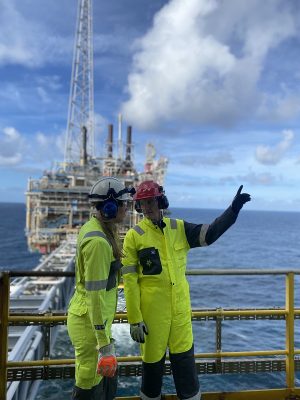
That message also emerged after the release earlier this week of a new report documenting the effects of climate change in Norway. Since climate change is directly linked to the effects of fossil energy and carbon emissions, Norway’s oil industry is widely viewed as contributing to it and making it worse.
“The time is right for closing this chapter (on oil exploration),” Nimrah Ramzan, acting leader of the Labour Party’s youth organization AUF, told newspaper Dagsavisen. Ramzan cited a need “to use our resources differently when we’re stuck in a climate crisis and Norway hasn’t met its own climate goals.”
The AUF leader added that “our own voters are giving us a clear signal that the party should listen to. It seems wise to at least reduce oil exploration.” AUF itself has already called for a halt to it, and wants the government to stop issuing new exploration licenses.
Norwegian politicians in power have long delayed implementation of any “green restructuring” of the Norwegian economy away from oil and gas, mostly because of all the billions of dollars and kroner generated by the industry. State oil and energy company Equinor reported billions more in profits for the third quarter this week, lower than those in the same quarter last year but mostly because the price of oil had fallen.
Equinor itself is in the midst of two major strategic processes tied to the future of the Norwegian Continental Shelf and its own portfolio of renewable energy projects. The company seems to be restructuring even if the country’s economy isn’t, and that may mean 5,000 fewer employees by 2030.
Equinor’s chief executive Anders Opedal said the company is concentrating on more wind power, and renaming its renewable (non-oil and gas) operations to, simply, “Power.” At the same time, he noted, “we see that the Norwegian shelf is changing. That means we’re going through how we operate there, how we’re organized, work processes and that sort of thing.” Equinor currently has around 25,000 employees. Those retiring may not be replaced externally, and newspaper Dagens Næringsliv (DN) reported that Equinor has effectively had a hiring freeze since May.
That suggests that even if the government itself doesn’t begin to phase out oil and gas activity, Equinor and other companies may do so themselves, in line with the markets they serve. Opedal has earlier stressed that Equinor will continue to search for and produce oil and gas for as long as possible, but production is nonethless expected to fall as Norway’s oil fields mature.
Most of Labour’s potential budget partners, meanwhile, intend to do what they can to reduce Norway’s oil and gas production. The Greens have four “concrete proposals” to start the phase-out: Halt oil exploration and new oil and gas investments, halt electrification of oil fields, impose higher carbon fees and start charging a “restructuring fee” on oil and gas sales.
The Reds and Socialist Left parties are expected to go along with that, since both also want to start phasing out the oil and gas business. The Center Party will likely object, but the Greens’ deputy leader Ingrid Liland has her arguments ready.
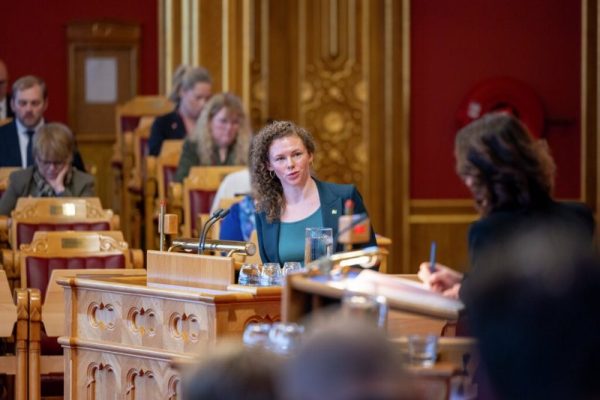
“What we’re most keen to establish is a restructuring plan that will allow Norway to continue to be a good energy partner for Europe, to maintain energy security and to secure Norwegian jobs during the transition period,” Liland told DN on Thursday. She thinks the oil sector can move into a low-emission future in two ways: Through a gradual and controlled phase-out beginning this year, or through shock when markets for oil and gas collapse. She prefers the former to the latter, to remove risk as Europe also cuts its consumption of fossil energy.
“Our plan also calls for stopping the oil industry’s demands on Norwegain competance, capital and now least power,” she said, suggesting that would allow mainland industry to blossom instead.
NewsinEnglish.no/Nina Berglund
