

The new war in the Middle East, which cut off oil shipments from the Persian Gulf, has sent oil prices up to well over USD 100 a barrel. That’s not necessarily good news for Norway’s oil-driven economy, warns Finance Minister Jens Stoltenberg just before he and government colleagues gather for the annual state budget conference.
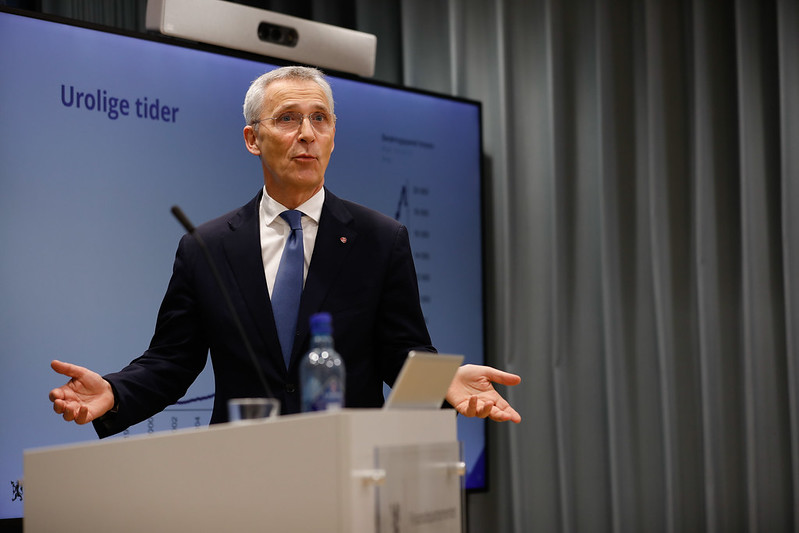
The former NATO chief and his fellow government ministers were already worrying about the war last week, right after US President Donald Trump and Israeli leader Benjamin Netanyahu started bombing Iran. Response was swift, and the war that erupted has trapped at least 150 ships in the Persian Gulf that otherwise would be carrying oil from all the oil-producing countries in the area.
The stranded ships, many of them Norwegian-owned or controlled, cut oil supply, leaving demand to drive up its price. Oil prices rose 28 percent last week and spiked when markets opened in Asia on Monday. Oslo-based newspaper Dagens Næringsliv (DN) reported that a barrel of Norway’s North Sea crude oil (Brent) traded as high as USD 119 before falling back to around USD 110.
It was trading at just over USD 108 early Monday morning, “reflecting,” according to DN, “a situation where investors are now preparing for long-term closure of the Iranian-controlled Straits of Hormuz,” the only exit from the Persian Gulf. While shipping rates have also risen, the inability to use oil tankers stuck in the gulf can be costly for nervous Norwegian shipowners and others, and they’re also liable to being attacked.
Stoltenberg, meanwhile, stressed during the weekend that “war is not good for the Norwegian economy” despite the oil price hikes it can bring. Norway is often viewed as profiting on war, not least because of higher oil and gas prices and all the revenues that brings to the country. The value of the Norwegian krone often strengthens as well, but it was weakening Monday morning, trading at NOK 9.6 against the US dollar. Last week a dollar cost around NOK 9.3.
“We are a small, open economy and are vulnerable to everything that happens out in the world, both as an exporting nation and an investor nation,” Stoltenberg told Norway’s largest newspaper Aftenposten on Saturday. Stock markets tumbled on Monday as well, meaning Norway’s huge sovereign wealth fund known as the Oil Fund can be hit, too.
Stoltenberg admitted that it’s a “paradox” how Norway can bring in extraordinary income on, for example, a jump in oil prices, but that also means Norwegians will be paying even more at the gas pumps than the current equivalent of USD 10 a gallon. Other prices can rise as well. Norway, like many other countries, is also spending much more on defense than ever before.
“War is always gruesome, people get killed, homes and valuables are destroyed,” said Stoltenberg, who spent 10 years leading the NATO alliance that’s also facing new uncertainty since Trump took office. “Now we have a new major war. It’s uncertain how long it will last and what the consequences will be, but we know it will affect the Norwegian economy.”
He conceded that it’s “an historic fact that war and conflict have led at times to higher prices for goods Norway exports.” He quickly added, however, that “even though the price of what we sell goes up, that doesn’t mean Norway earns on a war. We’re best-served with peace, also economically.”
Stoltenberg’s finance ministry is well underway with preparation of next year’s state budget, and this year’s will be subject to proposed revisions in May. All government ministers will be gathering at the prime minister’s office this week for the annual state budget conference that will last all day Tuesday and Wednesday.
The ministers usually gather at a local hotel and dress casually for the budget conference, at which all the ministers must compete for funding in their own areas. This year they’re staying in Oslo, another sign of troubled times and a desire to stay closer to home.
NewsinEnglish.no/Nina Berglund
