

UPDATED: Norwegians riding public transportation to 17th of May celebrations in the Oslo area over the weekend got a bit of a shock on the way: Metro cars were plastered with advertising calling for a halt to more public support for Ukraine, prompting one top politician to equate the ads to “Russian propaganda.” The ad campaign itself was halted Monday night, after lots of vandalism.
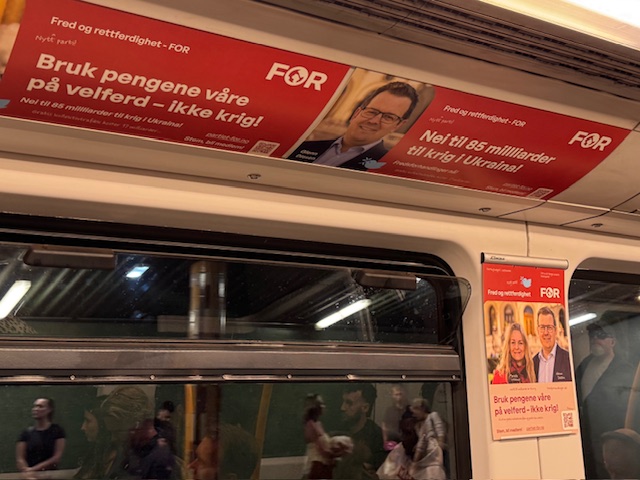
The advertising specifically objected to how the Norwegian Parliament has approved spending NOK 85 billion on what the small new Partiet Fred og rettferdighet – FOR (“The Party (for) Peace and justice”) calls “war in Ukraine.” The ads called for peace talks instead, and urge Norwegian politicians to rather spend such large amounts of money on more social welfare programs for Norwegians.
Many metro riders were offended by FOR’s message, though, especially on the biggest national holiday of the year in Norway that celebrates the country’s constitution and democracy. Surveys have shown how a vast majority of Norwegians favour both military and humanitarian support for Ukraine, since it was invaded by Russia more than three years ago. Norway has also taken in tens of thousands of Ukrainian refugees, and a major increase in the government’s funding proposals for Ukraine recently won unanimous support in Parliament.
That’s why public reaction to FOR’s advertising was extremely negative. “I think it’s distasteful to say ‘no’ to support for Ukraine and plaster that message up on the metro today,” said one offended Norwegian tipping newspaper Aftenposten to the ads. “There are Ukrainians here who are celebrating the 17th of May and freedom.”

Mathilde Tybring-Gjedde, a Member of Parliament for the Conservative Party, used social media to criticize the ad campaign and told Aftenposten how it missed the point, “because there won’t be peace in Ukraine if support doesn’t continue.”
“This is Russian propaganda,” Tybring-Gjedde told Aftenposten, “and I get really mad when hundreds of Ukrainian children who have fled to Norway have to see this message on the way to their parade.” She acknowledged FOR’s right to free speech and doesn’t think the campaign should have banned, but she and many others wanted to know where the party’s money for such a campaign was coming from.
By Monday questions were also flying after newspaper VG reported that the party was registered just a few months ago, in January, and claimed it only had NOK 50,000 (USD 5,000) in its treasury. The ad campaign itself was estimated to cost around NOK 1.4 million for one week, prompting the state commission in charge of enforcing campaign regulations to announce a probe into FOR’s funding after receiving several inquiries.

“We must investigate where this money is coming from and whether it’s a donation that is legal to receive,” commission leader Ragna Aarli told NRK. She stressed that openness about party financing is important, to maintain confidence among voters.
“This is about democratic processes and that (Norway’s national) election (in September) won’t be taken over by outsiders,” Aarli said. “We are a small country and can be vulnerable to foreign influence operations, without me saying that’s the case here.”
FOR party leaders initially refused to respond to questions about their finances but on Monday one of its candidates for office in Akershus said the money used on the ad campaign came from sources within Norway, not from abroad. Glenn Diesen, who’s featured in the ads, admitted to state broadcaster NRK, however, that he “really doesn’t have an overview” of the funding since he’s not a member of the new party’s board.
He declined to go into detail about who supports the party financially, but told NRK that support for the ad campaign came “from a Norwegian,” not a Russian, “but I don’t know if it’s from just one (Norwegian) or more.”
Around an hour later the party’s website crashed, with the party claiming it had been the victim of a data attack. Then came news that Norway’s domestic intelligence agency PST was aware of the controversy over the ads and following the situation, but declined further comment. It’s PST that monitors the biggest security threats to Norway, which have been tied to Russia and China for the past several years.
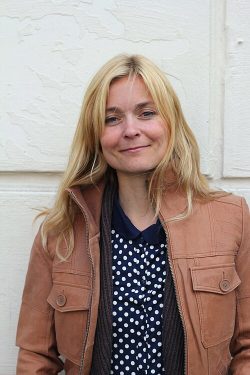
NRK reported that FOR was founded in 2023, opposes NATO (of which Norway is a founding member) and thinks Norway should not offer assistance to Ukraine after it was invaded by Russia in 2022. Its leader, Marielle Leraand, was formerly a deputy leader of Norway’s left-wing Reds Party, who said she thinks that “what’s distasteful … is to use the 17th of May holiday to spread propaganda for NATO.” She left the Reds Party when it first agreed with the government’s plans to send weapons to Ukraine.
After hearing that Oslo politician Hallstein Bjercke of the Liberal Party had called FOR’s ad campaign “trash,” she said that the Liberals “are, more than any other party, willing to risk nuclear war and the end of humanity in order to plant a blue-and-gold flag in Sebastapol.” Leraand also claimed that Ukraine is not a democracy and that freedom of expression in Ukraine is restricted.
She didn’t respond to Aftenposten’s questions about who financed the ad campaign for her party and refused to reveal the party’s money source to NRK. “We have no problem with a probe into this,” Leraand told NRK. “It’s fine that they (the campaign commission) are looking into this, and we have nothing to hide.”
Public transport firm Ruter said that metro operator Sporveien was responsible for the ad campaign. Sporveien claimed it was in line with Norwegian law and applicable regulations. It wouldn’t comment on who paid its bill for the campaign, which FOR sought to terminate Monday night. The party complained in a statement that Sporveien hadn’t been able to uphold the contract because of “systematic, politically motivated vandalism directed at our posters.” The party said money not paid out to Sporveien would be used to send its anti-war message in other arenas.
NewsinEnglish.no/Nina Berglund
