

Norwegian Prime Minister Jonas Gahr Støre had to divert attention this week from international crises to another one looming at home. His government’s proposed state budget lacked support from two of his four negotiating partners, but he was confident they’d ride out the storm and they did.
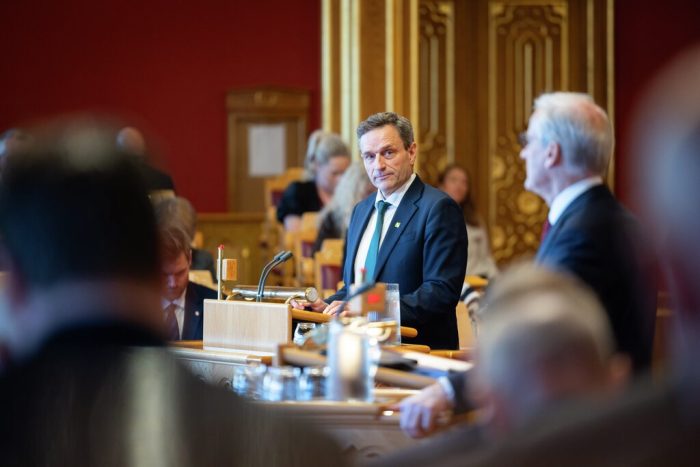
Støre was far from alone in expecting he’d come to terms with the Greens Party and its leader Arild Hermstad by Friday, when the budget needed to be ratified in Parliament. “There is no crisis now,” he told reporters on Monday. Budget negotiators from his Labour Party kept talking with both the Greens and the Socialist Left Party (SV) after negotiations broke down over the weekend.
They reached a settlement at 2am on Wednesday in what opposition leaders called “chaos” that Støre brushed off. The budget itself has not been changed, but the Greens seemed pacified by an agreement to set up a new commission charged with guiding the restructuring of Norway’s economy away from oil.
“We will now start writing the last chapter in Norwegian oil history and open up for all the new projects that can build Norway further,” Greens negotiatior Ingrid Liland told Norwegian Broadcasting (NRK) later on Wednesday morning. She claimed that both industry professionals and environmentalists can now be able to come together and “develop the economy in a phase when the Norwegian continental shelf becomes less active. It will be a lot less ‘drill,baby, drill’ than it’s been until now.”
Støre, confronted with criticism from pro-oil parties like Progress and Center, stressed that “there’s not one word (in the state budget)” about dismantling the oil industry while acknowledging that an energy shift will come regardless, and that all politicians must follow it.
He had been optimistic that he and Greens leader Hermstad would settle their differences. “I have time and respect for political discussions,” Støre said on Tuesday. “My goal is find a solution so that our country can get a budget.”
Støre had stayed out of the negotiations that went on for two weeks among Labour, the Center Party, the Reds, the Greens and SV. Both Center and the Reds agreed to support the state budget that had to be formally presented to Parliament on Sunday.
The Greens, however, refused to do so after Labour and Center wouldn’t modify it with a controversial plan to eventually phase out Norway’s oil and gas industry. SV, meanwhile, still wanted Norway’s huge Oil Fund to sell off stakes in Israeli companies that threaten the Palestinians. Most everyone else claimed that would politicize the Oil Fund.
SV ended up accepting its loss over demands tied to the Oil Fund, but was able to cheer over increased state funding for state dental care and an earlier decision to halt deep-sea mining at least for the rest of the current four-year parliamentary session.
It all left Labour without the majority it needed in Parliament to get its budget passed. Støre and his newly re-elected government otherwise faced having to turn over government power to the opposition, even though they wouldn’t have had a majority in Parliament either.
Brenna had claimed on Monday that she was already having “good conversations” with both Hermstad of the Greens and SV leader Kirsti Bergstø. Neither the Greens’ nor SV’s leaders could ignore, moreover, the negative feedback they were getting from many of their own party members.
Newspaper Dagsavisen reported on Tuesday that Greens members were split over Hermstad’s budget negotiating tactics, fearing he has “overplayed his role,” while SV members weren’t entirely pleased by SV’s hard line on Palestine.
Others, including both of Norway’s left-leaning newspapers, also claimed the Labour-Center-Reds budget proposal was a “good” one. “It’s difficult to claim that the budget … doesn’t represent breakthroughs for the entire red-green coalition,” editorialized newspaper Klassekampen on Monday. It noted how the revised budget provides an additional NOK 4 billion in state funding for hard-pressed local governments around Norway, improves dental health care, offers more support for families with small children, increases carbon emissions fees on offshore oil installations and perhaps most importantly of all, reverses the government’s earlier approval of contoversial deepsea mining, at least through the current parliamentary session that runs until 2029. It had been delayed last year.
While Klassekampen called the Greens budget expectations “unrealistic,” Dagsavisen editorialized about how important it is for Norway’s five parties on the left side of politics “to hang together.” Klassekampen also thought the Støre government has done a good job: “The budget proposal on the table now is a good one … it points in the right direction for the country.” All involved should be celebrating that, Dagsavisen wrote, not “descending into more disagreement and quarreling.”
Most important, they claimed, was to keep the conservative Progress Party leader Sylvi Listhaug from replacing Støre as prime minister. That’s could have happened since Progress is now the largest party in opposition. Listhaug announced Tuesday morning that she was “prepared to take over responsibility,” but conceded that the left-side would still have a majority in Parliament. “I expect them to tidy up this chaos that has now arisen,” Listhaug told Norwegian Broadcasting (NRK). They did, and now the political debate over issues can resume in Parliament.
NewsinEnglish.no/Nina Berglund
