

Anders Opedal, chief executive of Norway’s state oil and energy company Equinor, made it clear this week that he’s not at all happy that oil policy has been playing a role in this year’s state budget negotiations. He doesn’t want the framework for the country’s oil and gas industry to be changed by political parties more concerned about climage change and the environment than jobs and the Norwegian economy.

“I’m worried that oil and gas policy is being discussed at the budget negotiations,” Opedal told newspaper Dagens Næringsliv (DN) this week, when Equinor was holding an annual conference in Oslo. “I don’t think it’s right that this is going on behind closed doors. Policy should be discussed in the Parliament, in the usual manner.”
The budget negotiations were later disrupted when the environmentally oriented Greens Party (MDG) walked out, and Opedal may find comfort in the reason: The Greens’ leaders were too frustrated by the Labour- and Center Party’s alleged refusal to discuss plans for phasing out oil and gas production in the years ahead. Labour formed its own minority government after the last election, when it emerged as Norway’s largest party even with only 28.2 percent of the vote. It thus seeks support for its state budget proposal from the four other left-center parties in Parliament.
They’ve been huddling for the past two weeks but both the Greens and the Socialist Left Party (SV) went into “pause” mode on Friday when they lost patience with Labour and Center. While the Greens withdrew entirely on Saturday, SV resumed negotiations but it also has various demands for cutting emissions and reining in the oil industry. So does the Reds Party. At the very least they’d like to finally start working on an official plan to restructure Norway’s economy away from the oil and gas industry, which has contributed by far the most money to the state budget over the past several decades.
That disturbs Equinor’s CEO Opedal, who told DN that he has never experienced more uncertainty in his business than now. During his remarks at his mostly state-owned company’s conference, he stressed that worldwide uncertainty and all the new defense and security concerns tied to Russia’s invasion of Ukraine have made oil and gas more important than ever.
“High interest rates and security have replaced sustainability as the highest political priorities,” Opedal said. He claimed that even the International Energy Agency (which earlier wanted to halt more oil and gas exploration because of climate concerns) now thinks more oil and gas investment is necessary, just to maintain current production levels. The UN, however, remains skeptical to ongoing oil exploration and production.
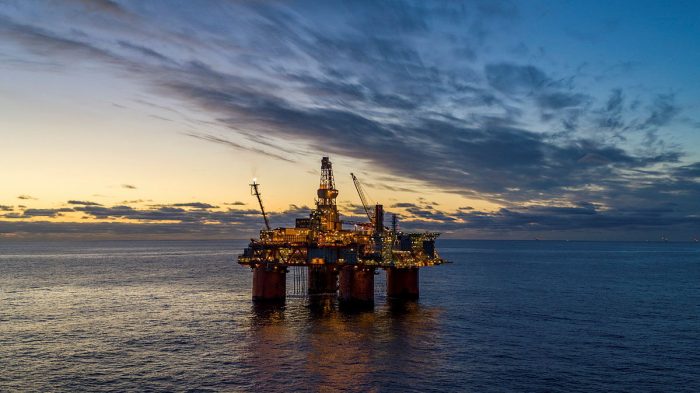
Oil prices, meanwhile, are currenly lower than expected while production costs are rising, and gas prices are uncertain. Equinor’s own efforts to diversify into renewable energy projects like wind power, all part of the company’s “Energy Transition Plan,” have met lots of obstacles and market skepticism.
Equinor recently unveiled a restructuring plan of its own, not least after its own shares have tumbled this year. It has reduced its investment in renewables, and is more keen now on renewing and developing its Norwegian offshore operations. Opedal also expressed disappointment that the market for carbon capture and storage and blue hydrogen haven’t developed as expected.
This is all why he doesn’t want Norwegian party leaders to bring climate and environmental issues into state budget negotiations, even as climate activists demonstrated outside Equinor’s conference venue this week. Opedal can probably seek ongoing support for oil and gas from not just the Labour- and Center parties but also the Conservatives and the more conservative Progress Party. They may even end up supporting Labour’s budget in the end, with some revisions.
Equinor itself claims it’s “dedicated to delivering energy the world needs today, while developing energy solutions for tomorrow,” and that it still wants to be “a leading company in the energy transition and to achieve net zero emissions in 2050.”
NewsinEnglish.no/Nina Berglund
