

Norwegian telecommunications company Telenor reported disappointing first-quarter earnings this week, as the US’ war on Iran hurts its Asian operations. The state-controlled company also faces tumbling share prices, a major class-action lawsuit filed on behalf of former Telenor customers in Myanmar and an investigation in Parliament.
Telenor’s bottom line was positive, after the company logged an extraordinary gain on the sale of operations in Thailand. That yielded a pre-tax result of NOK 9.4 billion, up from NOK 3.6 billion in the first quarter of last year.
Total revenues, however, were down 1.4 percent and operating results up by just 2 percent. Its share price plummeted on the news, falling by as much as 7 percent at one point this week. The company still claims it’s financially strong, with CEO Benedicte Fasmer calling it “solid” after the recent sale in Thailand, but she noted how the company will now concentrate on more “disciplined” investments “in our core market” in the Nordic countries.
Fasmer, who took over for former CEO Sigve Brekke in December 2024, now seems charged with pulling Telenor out of Brekke’s and his predecessor Jon Fredrik Baksaas’ often-troubled expansion into Eastern Europe and Asia over the past two decades. Investments in Bangladesh (now severely troubled by oil shortages and soaring prices because of the US’ and Israel’s attacks on Iran), India, Bulgaria, Uzbekistan and not least Myanmar have all caused lots of trouble. They were actively backed by top government officials (the Norwegian state owns 54 percent of Telenor’s shares) but the markets proved to be risky, because of corruption, bribery and political turmoil.

Myanmar, the former Burma, proved to be the worst. Telenor had hoped to be part of what seemed to be an emerging democracy in a resource-rich country. All that changed when military leaders clung to power, restrained and re-arrested Nobel Peace Prize winner Aung San Suu Kyi and ultimately staged a new coup in February 2021, right in the middle of the pandemic.
Telenor already had 18 million mobile telephone customers in Myanmar at the time. The company claims it had to make difficult decisions “under significant pressure from the military regime and international sanctions,” in what it has called “a war zone.” Telenor ended up turning over data on its customers to the military authorities in an attempt to protect its employees and finally pulled out of the country in 2022.
“To deny the military authorities (access to the data) could have meant imprisonment, torture or death sentences” for them, Telenor information chief David Fidjeland recently told Oslo-based newspaper Dagens Næringsliv (DN). He insists the company had no “real choice,” adding that “we couldn’t play Russian roulette with our employees’ lives.”
Many of Telenor’s customers, however, were subsequently arrested, imprisoned, tortured and even killed. That has prompted the Swedish non-profit association Justice and Accountability Initiative (JAI) to file a civil class action lawsuit on the victims’ behalf against Telenor in the district court in Asker and Bærum, where Telenor is headquartered just west of Oslo.
The lawsuit, supported by the Centre for Research on Multinational Corporations (SOMO) and the Open Society Justice Initiative (OSJI), seeks damages for Telenor’s decision to turn over the data of customers who were suspected by the military authorities of opposing the 2021 coup. DN has reported that the damages sought (EUR 9,000 for every person victimized by the release of their data) can amount to around EUR 11.3 million (NOK 126 million).

The organizations filing and supporting the lawsuit, with JAI representing refugees from Myanmar now in exile in Sweden, call it a “landmark” case (external link to SOMO’s website) because of how dangerous it’s become for corporations to operate in fragile democracies and authorian countries. They’ve hired one of Oslo’s major law firms, Simonsen Vogt Wiig, to represent them and drive home the point that sharing data can be fatal. At the very least, the plaintiffs claim Telenor is guilty of serious human rights violations.
That’s what also makes the case difficult to digest for Telenor and Norwegian government officials alike. Norway has long been an international advocate of human rights, democracy and foreign aid to promote both. Now it’s being accused of just the opposite.
That’s also prompted a parliamentary investigation into the entire case and the state auditor may get involved as well. Some of Telenor’s own executives were effectively held in Myanmar by the coup leaders and the drama went on for months, but it’s the decisions Telenor ultimately made that are under probe.
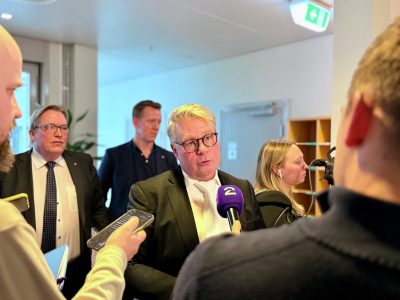
Per-Willy Amundsen, leader of the Norwegian Parliament’s disciplinary committee, has called for the state auditor to join the investigation into Telenor’s history in Myanmar. He’s frustrated by tensions between the committee and the government, after the trade ministry has denied to turn over documentation of its so-called “owner dialogue” with Telenor. The government is now under Labour Party control, but like the former Conservatives-led government, it seems protective of the former public telecommunications utility in which it holds a majority stake.
Members of Parliament want to know what the government knew about Telenor’s decision to deliver sensitive customer information to the military coup leaders in Myanmar. Current Trade Minister Cecilie Myrseth claims the government’s “owner dialogue” with all companies in which it’s invested “must remain confidential in order to function.”
Amundsen, from the conservative Progress Party on the right, and fellow committee member Lars Haltbrekken from the Socialist Left party, agree that calling in the state auditor “is the right way to go.” Amundsen stressed that it’s the committee’s responsibility to determine whether Telenor has violated human rights in Myanmar. “That tops our agenda,” he told state broadcaster NRK last week, while acknowledging that the committee’s probe will likely need to extend into the autumn.
NewsinEnglish.no/Nina Berglund
