

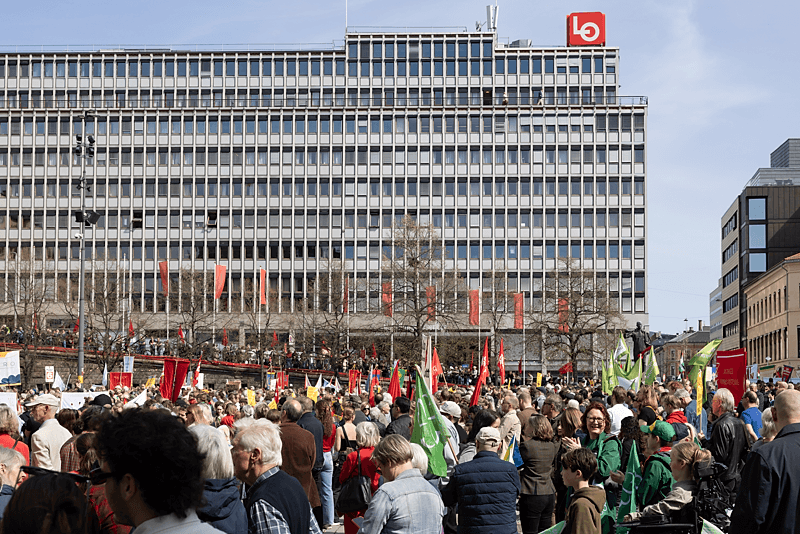
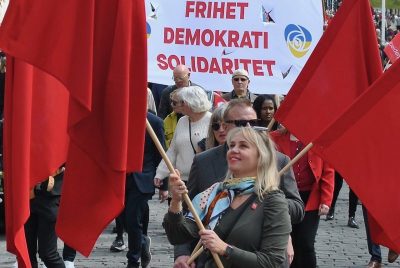
The sun shone warmly over much of Norway on Friday’s May 1st holiday, and hundreds of thousands turned out for Labour Day parades and demonstrations. Some felt a need to defend the tradition, even though Norwegian labour unions remain strong and have won credit for the country’s relatively small social differences.
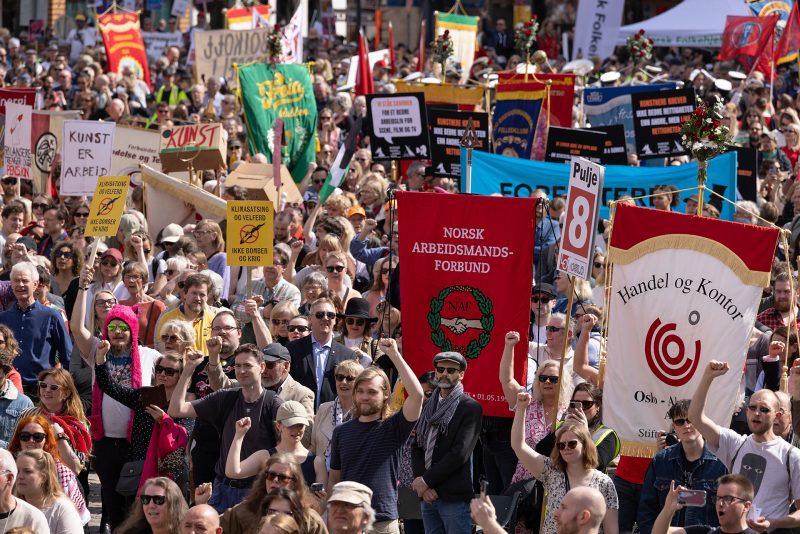
This year’s May Day holiday arrived after the conservative leader of the Christian Democrats Party’s youth group had controversially proposed eliminating May 1st as a paid holiday. Ingrid Olina Hovland claimed the holiday has become more a celebration of Norway’s left-wing parties than workers, and has thus “outplayed its role” in Norwegian society.
Hovland, known for also opposing abortion, went so far as to claim that most Norwegians spend May Day “gardening at the state’s expense.” She said the holiday costs the state around NOK 3 billion and suggested moving the paid holiday to May 8th, which has officially been dubbed as both Liberation- and Veterans’ Day but isn’t a paid day off.
Support for her proposal ended up in line with the Christian Democrats Party’s weak voter support, currently around just 3 percent. Some even responded to Hovland’s proposal by suggesting cuts in annual state support for churches in Norway, which also costs around NOK 3 billion a year.
Even the relatively conservative newspaper Aftenposten, the country’s largest, felt a need to publicly support the May Day holiday this year. “Hurrah for the 1st of May” read the headline on the paper’s main editorial on Thursday. It went on to question Hovland’s budget estimates, and wrote that May Day is a day “for fellowship in the spirit of nation-building.”
That’s especially important now, wrote Aftenposten, at a time of international polarization and unrest. It noted how Norway’s Labour Day holiday was first celebrated in 1890, when calls for an eight-hour workday dominated. Two of the other paid holidays in May, it added, are tied to Christian traditions, Ascension Day and the Pentecost, which presumably should be enough to satisfy Hovland’s Christian Democrats Party.
“The labour movement’s growth and participation in public life are pillars within Norway’s history, economy and democracy,” editorialized Aftenposten. “An organized labour system is a strength, and an important part of the Norwegian model.”
That model, in which the labour movement, employers’ organizations and politicans make efforts to work together, has also recently won credit for Norway’s high standard of living and low social differences compared to many other countries like the USA or Great Britain. Newspaper Dagens Næringsliv (DN), Norway’s main business daily, reported on a recent study carried out by professors at the University of Chicago, the University of Oslo and Norwegian business school NHH, in which they attempted to explain how Norway and other Nordic countries manage to combine growth and welfare with a stable and egalitarian system.
Among measuring sticks are the differences between executive pay and that of salaried workers. The gap is much narrower in Norway, where an average salary is around NOK 700,000 (USD 76,000) and an executive’s pay around NOK 3 million. Executive pay at the country’s largest companies can often hit NOK 20 million (USD 2.2 million, including benefits and bonus) but base executive pay is generally a much smaller multiple of average salaries than elsewhere.
The professors’ report, published in the Journal of Economic Literature, found that the 10 percent of those with the highest pay in the Nordics amounted to twice that of the 10 percent earning least. In the USA it was five times as much.
The social welfare states found in Norway and other Nordic countries have long sought to reduce differences among their citizens, mostly through tax systems meant to finance free health care and schooling through the university level. In addition come paid maternity- and paternity leave for around a year, heavily subsidized day care centers and unemployment pay, while state agencies help people find work.
“Politicians like to take the credit for having smaller social differences than elsewhere,” NHH Professor Kjell Salvanes told DN. That’s true in many areas, but the main reason for narrower pay gaps in Norway, they found, is the strength of organized labour and how extensive it is. Around 60 percent of all employees in the Nordic countries are members of labour unions, and annual wage negotiations are highly coordinated between trade union confederations and employer organizations representing various industries and businesses across the board.
In the USA, only 10 percent of workers are organized and 25 percent in Great Britain, and their unions often negotiate directly with their members’ employers instead of employers’ organizations. They lack the coordination of wage and benefit negotiations and settlements that make negotiations less personal and more professional.
The professors concluded that coordinated wage and benefit negotiations are the most important explanation for the much lower social differences in the Nordics than in the US and Great Britain. They account for fully 70 percent of the difference in wage disparity between just the US and the Nordics.
Norway’s labour movement this year has also been characterized by far fewer strikes, after a 4.4 percent wage hike was agreed at the outset of the spring negotiating season among labour organizations and major industrial employers. That settlement sets the tone for all other negotiations, with only a few other strikes so far including one by hotel and restaurant workers.
The Nordic work model also reflects high productivity and relatively high income per inhabitant, who also score high on global “happiness” surveys. That can explain why many dress up for May Day events and celebrations.
“For me, the 1st of May is like Christmas Eve,” 62-year-old Ingunn Gjerstad, leader of LO in Oslo, told newspaper Dagsavisen. “It’s a day for fellowship.” She remains worried that wage gaps may be widening amongst workers and their executives, but is proud of the labour sector’s accomplishments over the years.
She scoffed at the Christian Democrats youth leader’s proposal to scrap the May 1st holiday.
“I think that was lacking history and knowledge about what the day is all about,” Gjerstad said, “so we won’t worry about it.”
NewsinEnglish.no/Nina Berglund
